
Early Years Blog
Insights, tips, and best practices for early childhood educators and administrators
Share your voice with the Child Paths community
At Child Paths, we believe education is most powerful when shared. We’re looking for professional, human, and grounded perspectives from managers, owners, and parents. Whether it’s research summaries, opinion pieces, or stories from practice, your insight moves the sector forward.
Contribute with usRead full Guidelines
- Professional but friendly tone
- Clear, jargon-free and accessible
- Evidence-informed & reflective
"We want posts to feel human—as if you're sharing thoughts with a colleague over coffee."
Latest From Our Blog
Stay up to date with the latest insights in early
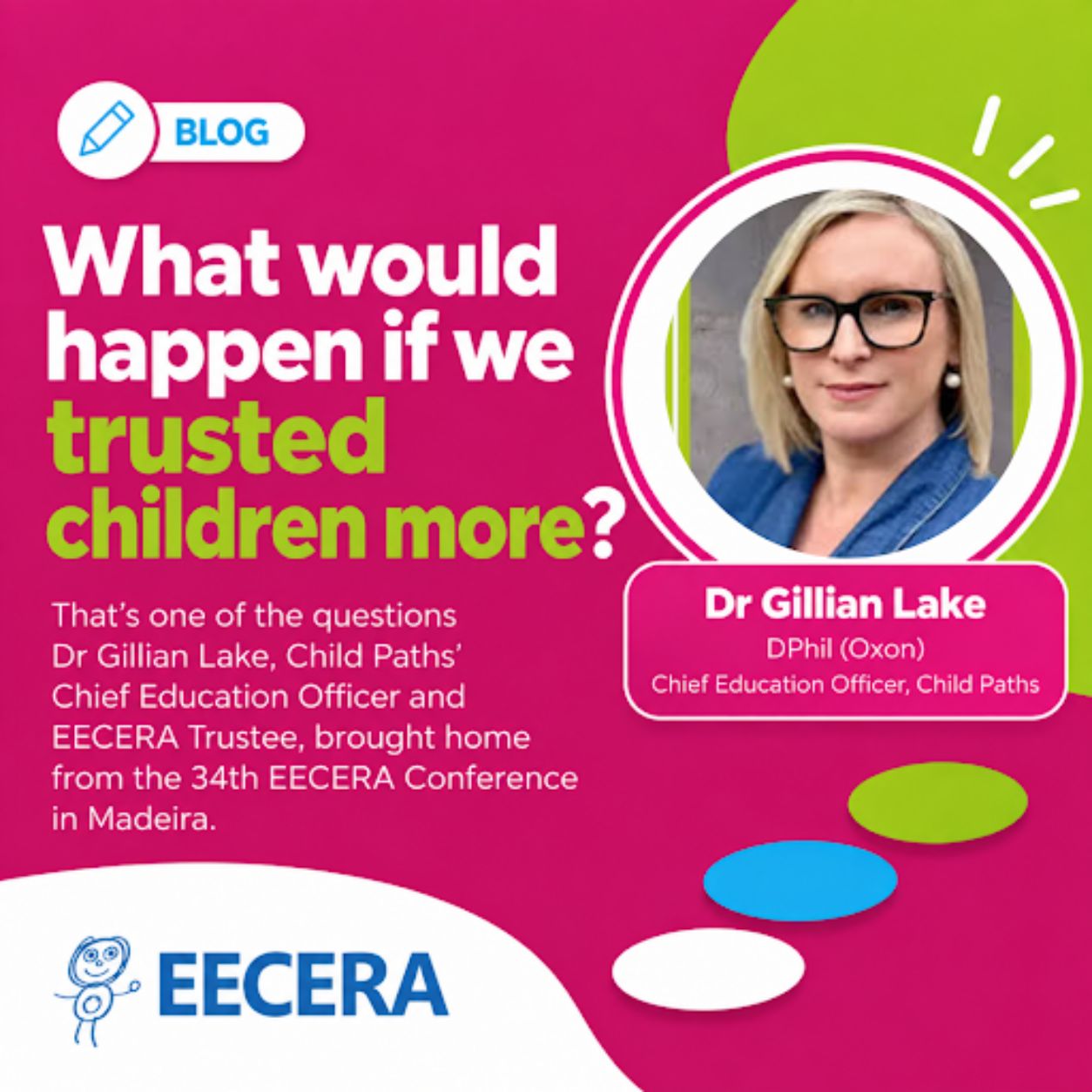
What does democracy look like in a post-digital early childhood world?
Reflections from the 34th European Early Childhood Education Research Association Conference, Madeira, August 2026
Dr Gillian Lake, Chief Education Officer, Child Paths; EECERA Trustee
I was fortunate enough to attend the 34th European Early Childhood Education Research Association (EECERA) Conference this year on the beautiful and tropical island of Madeira. What an experience that was.
My work as an EECERA Trustee is only getting started, and I feel incredibly fortunate to be able to sit alongside colleagues from across the world and listen to the wonderful stories of research being undertaken in early childhood. Ireland, New Zealand, Hungary, Spain, Australia, Turkey, Portugal and many other countries were represented among the near 800 delegates, creating a rich tapestry of research approaches, perspectives and cultural nuances.
And then there was Madeira.
The warmth of the island, the warmth of its people and the warmth of the conversations made for a very memorable few days.
But it was the conference theme, democracy and participation in early childhood education, that stayed with me most strongly. It could hardly have been more relevant.
In her presidential address, our EECERA President, Professor Chris Pascal, spoke eloquently about the shifting and challenging world of what she described as polycrises. We are living through considerable social, political and technological change, and early childhood does not sit outside of that. Quite the opposite. Our youngest children are growing up in a world where the boundaries between digital and non-digital life are increasingly difficult to distinguish.
So, what does democracy and participation mean for young children in a post-digital world?
That question followed me throughout the conference.
Technology, participation and the child
Professor Suzy Edwards’ keynote gave us much to think about. She challenged us to investigate the philosophy of technology, rather than simply thinking about technology as a collection of tools that we choose to use or not use.One of the most delightful examples she shared came from her research into digital literacy through play using unplugged technology artefacts. Children played with wooden versions of familiar technological objects, including mobile phones. One child carried a wooden phone pressed against their upper chest, while several others repeatedly checked the charging status throughout the day. These beautiful little vignettes showed children drawing on their understandings of technology and incorporating them into their play, relationships and meaning making.
Professor Edwards asked us to consider how we can advance democracy for children in a post-digital world. The idea of critical constructivism particularly resonated with me and with it, the notion that our values need to be considered within the design of technology itself.
This is an important challenge for anyone designing digital tools for educators. Technology is never entirely neutral. What we make visible, what we make easy, what we ask educators to record and what we leave space for all carry values.
The opportunity is to design technology that supports professional agency rather than replacing it. Tools can provide possibilities, connections and prompts, while educators remain the people making the professional decisions.
And that same principle of agency was echoed throughout the conference.
One study exploring children’s participation reminded us that participation does not always look loud. The child running, shouting and actively communicating is participating, but so too is the child watching carefully from the edge, listening, quietly constructing or taking the time to work out what they want to say. If we are to understand children’s participation, we need to stop and really look and listen with our eyes.
That has implications not just for how we observe children, but for how we design environments, curriculum and the systems we use to document learning. If we only capture what is easily visible or measurable, we risk creating a very narrow picture of children’s agency.
Another study explored children’s agency during shared book reading and demonstrated how actively children use illustrations to communicate, interpret and make sense of stories. It was a lovely reminder that the whole book is an opportunity for participation, not simply the words on the page.
I was also struck by research examining the phrase “best interests of the child.” It is a phrase we use constantly and indeed is represented in worldwide documents including the UNCRC. Yet there is no single shared definition of what it means. Often, children’s best interests are defined from an adult or professional perspective.
But what do children themselves believe is in their best interests?
That simple question challenges us to think differently about power. If we genuinely believe in participation, perhaps we need to become more comfortable with making decisions with children rather than simply for them.Reema Patel’s keynote reinforced this beautifully through the idea of “nothing about them without them.” Her work on activating agency with Elgon Social Research made us think about the role adults play in creating the conditions for participation, and whether technology can enhance children’s life chances rather than simply becoming another mechanism for managing risk.
And then came Professor Julia Forminsho, our own EECERA Trustee and a personal hero of mine.
Julia spoke with such care about pedagogy and participation, reminding us that democracy begins with us. Before we can genuinely enable children’s participation, we need to examine our own mindsets.
Her emphasis on “we-ness” and on creating space for voice and time, what she described as ethical suspension, really stayed with me. We need to allow children’s curiosity, questioning and intuition to develop.
The response from the room said everything. A spontaneous standing ovation followed her keynote. It felt like a moment of collective recognition.
What might we take forward?
Across the conference, I kept returning to one central idea: real participation requires a shift in power.
For educators, this means questioning our assumptions about what participation looks like and becoming better at noticing the quieter, less immediately visible ways children communicate.
For researchers, it means continuing to ask whose voices are represented and whose are missing.
For those designing technology for educators, it means thinking carefully about the values embedded within our systems. Digital tools can make things easier, but they can also shape what we notice, what we record and what we consider important.
Perhaps our ambition should be technology that helps educators listen more deeply, respond more flexibly and exercise their professional judgement.
Technology should not close possibilities. It should open them up.
I also attended sessions exploring folk tales and children’s wellbeing, reviews of ECERS, STEAM in early childhood and the challenges of supporting indigenous languages in early literacy. The breadth of the research was extraordinary and once again reminded me that early childhood education cannot be separated from questions of identity, culture, language, wellbeing, relationships and society.
We also heard about the realities facing the early childhood workforce in Ireland, including staff turnover of 22.4%, with pay and conditions continuing to create significant challenges. It was striking to hear similar concerns echoed across many of the countries represented.
And then there was Madeira itself.
The wonderful APEI team who organised the conference on the ground. The taxi drivers greeting us with a smile as they navigated the many hills of Funchal. The sunset boat trip, complete with dolphins and whales frolicking alongside us. The lights of the houses scattered across the hillside as we sailed back into Funchal.
And, thankfully, the little fan in our conference bags, which became one of my most treasured possessions in the Madeira heat!
Leaving Madeira
Perhaps my biggest takeaway was not a particular paper, model or presentation. It was a renewed belief in the importance of real participation.
Laura Lundy’s model continues to provide such a valuable foundation for thinking about children’s participation, and it was wonderful to see it underpinning so much of the research being presented.
The friendships made and maintained over those few days were just as important as the formal programme. Conferences such as EECERA remind me that research is not something that happens in isolation. It is a conversation that crosses countries, cultures, disciplines and perspectives.
I left Madeira feeling energised.
Energised by the research.
Energised by the conversations.
Energised by the friendships.
And energised by the responsibility we have to continue advocating for, researching with and engaging meaningfully with early childhood education.
The question of democracy is not going away. Nor should it.
If anything, as our world becomes more complex and more digital, our commitment to children’s voice, agency and participation needs to become stronger.
We need to keep asking:
Who gets to decide?
Whose voice are we hearing?
What are we overlooking?
And perhaps most importantly:
What would happen if we trusted children a little more?
There is much work to do.
And I am very glad to be part of it.
Bring on Zagreb EECERA 2027!
Reflections from the 34th European Early Childhood Education Research Association Conference, Madeira, August 2026
Dr Gillian Lake, Chief Education Officer, Child Paths; EECERA Trustee
I was fortunate enough to attend the 34th European Early Childhood Education Research Association (EECERA) Conference this year on the beautiful and tropical island of Madeira. What an experience that was.
My work as an EECERA Trustee is only getting started, and I feel incredibly fortunate to be able to sit alongside colleagues from across the world and listen to the wonderful stories of research being undertaken in early childhood. Ireland, New Zealand, Hungary, Spain, Australia, Turkey, Portugal and many other countries were represented among the near 800 delegates, creating a rich tapestry of research approaches, perspectives and cultural nuances.
And then there was Madeira.
The warmth of the island, the warmth of its people and the warmth of the conversations made for a very memorable few days.
But it was the conference theme, democracy and participation in early childhood education, that stayed with me most strongly. It could hardly have been more relevant.
In her presidential address, our EECERA President, Professor Chris Pascal, spoke eloquently about the shifting and challenging world of what she described as polycrises. We are living through considerable social, political and technological change, and early childhood does not sit outside of that. Quite the opposite. Our youngest children are growing up in a world where the boundaries between digital and non-digital life are increasingly difficult to distinguish.
So, what does democracy and participation mean for young children in a post-digital world?
That question followed me throughout the conference.
Technology, participation and the child
Professor Suzy Edwards’ keynote gave us much to think about. She challenged us to investigate the philosophy of technology, rather than simply thinking about technology as a collection of tools that we choose to use or not use.One of the most delightful examples she shared came from her research into digital literacy through play using unplugged technology artefacts. Children played with wooden versions of familiar technological objects, including mobile phones. One child carried a wooden phone pressed against their upper chest, while several others repeatedly checked the charging status throughout the day. These beautiful little vignettes showed children drawing on their understandings of technology and incorporating them into their play, relationships and meaning making.
Professor Edwards asked us to consider how we can advance democracy for children in a post-digital world. The idea of critical constructivism particularly resonated with me and with it, the notion that our values need to be considered within the design of technology itself.
This is an important challenge for anyone designing digital tools for educators. Technology is never entirely neutral. What we make visible, what we make easy, what we ask educators to record and what we leave space for all carry values.
The opportunity is to design technology that supports professional agency rather than replacing it. Tools can provide possibilities, connections and prompts, while educators remain the people making the professional decisions.
And that same principle of agency was echoed throughout the conference.
One study exploring children’s participation reminded us that participation does not always look loud. The child running, shouting and actively communicating is participating, but so too is the child watching carefully from the edge, listening, quietly constructing or taking the time to work out what they want to say. If we are to understand children’s participation, we need to stop and really look and listen with our eyes.
That has implications not just for how we observe children, but for how we design environments, curriculum and the systems we use to document learning. If we only capture what is easily visible or measurable, we risk creating a very narrow picture of children’s agency.
Another study explored children’s agency during shared book reading and demonstrated how actively children use illustrations to communicate, interpret and make sense of stories. It was a lovely reminder that the whole book is an opportunity for participation, not simply the words on the page.
I was also struck by research examining the phrase “best interests of the child.” It is a phrase we use constantly and indeed is represented in worldwide documents including the UNCRC. Yet there is no single shared definition of what it means. Often, children’s best interests are defined from an adult or professional perspective.
But what do children themselves believe is in their best interests?
That simple question challenges us to think differently about power. If we genuinely believe in participation, perhaps we need to become more comfortable with making decisions with children rather than simply for them.Reema Patel’s keynote reinforced this beautifully through the idea of “nothing about them without them.” Her work on activating agency with Elgon Social Research made us think about the role adults play in creating the conditions for participation, and whether technology can enhance children’s life chances rather than simply becoming another mechanism for managing risk.
And then came Professor Julia Forminsho, our own EECERA Trustee and a personal hero of mine.
Julia spoke with such care about pedagogy and participation, reminding us that democracy begins with us. Before we can genuinely enable children’s participation, we need to examine our own mindsets.
Her emphasis on “we-ness” and on creating space for voice and time, what she described as ethical suspension, really stayed with me. We need to allow children’s curiosity, questioning and intuition to develop.
The response from the room said everything. A spontaneous standing ovation followed her keynote. It felt like a moment of collective recognition.
What might we take forward?
Across the conference, I kept returning to one central idea: real participation requires a shift in power.
For educators, this means questioning our assumptions about what participation looks like and becoming better at noticing the quieter, less immediately visible ways children communicate.
For researchers, it means continuing to ask whose voices are represented and whose are missing.
For those designing technology for educators, it means thinking carefully about the values embedded within our systems. Digital tools can make things easier, but they can also shape what we notice, what we record and what we consider important.
Perhaps our ambition should be technology that helps educators listen more deeply, respond more flexibly and exercise their professional judgement.
Technology should not close possibilities. It should open them up.
I also attended sessions exploring folk tales and children’s wellbeing, reviews of ECERS, STEAM in early childhood and the challenges of supporting indigenous languages in early literacy. The breadth of the research was extraordinary and once again reminded me that early childhood education cannot be separated from questions of identity, culture, language, wellbeing, relationships and society.
We also heard about the realities facing the early childhood workforce in Ireland, including staff turnover of 22.4%, with pay and conditions continuing to create significant challenges. It was striking to hear similar concerns echoed across many of the countries represented.
And then there was Madeira itself.
The wonderful APEI team who organised the conference on the ground. The taxi drivers greeting us with a smile as they navigated the many hills of Funchal. The sunset boat trip, complete with dolphins and whales frolicking alongside us. The lights of the houses scattered across the hillside as we sailed back into Funchal.
And, thankfully, the little fan in our conference bags, which became one of my most treasured possessions in the Madeira heat!
Leaving Madeira
Perhaps my biggest takeaway was not a particular paper, model or presentation. It was a renewed belief in the importance of real participation.
Laura Lundy’s model continues to provide such a valuable foundation for thinking about children’s participation, and it was wonderful to see it underpinning so much of the research being presented.
The friendships made and maintained over those few days were just as important as the formal programme. Conferences such as EECERA remind me that research is not something that happens in isolation. It is a conversation that crosses countries, cultures, disciplines and perspectives.
I left Madeira feeling energised.
Energised by the research.
Energised by the conversations.
Energised by the friendships.
And energised by the responsibility we have to continue advocating for, researching with and engaging meaningfully with early childhood education.
The question of democracy is not going away. Nor should it.
If anything, as our world becomes more complex and more digital, our commitment to children’s voice, agency and participation needs to become stronger.
We need to keep asking:
Who gets to decide?
Whose voice are we hearing?
What are we overlooking?
And perhaps most importantly:
What would happen if we trusted children a little more?
There is much work to do.
And I am very glad to be part of it.
Bring on Zagreb EECERA 2027!
- Crobstacle
- September 11, 2026
From Principles to Practice: How the Revised Curriculum Preparation Feature Supports Inclusive, Rights-Based Early Learning
As the revised early childhood curriculum framework Aistear is implemented in Ireland, many educators are asking the same question: What does this look like in everyday practice? While the revised curriculum introduces important developments around children’s rights, inclusion and participation, its greatest strength lies not in presenting new ideas, but in deepening our understanding of what quality practice already aspires to be.
This is where the revised Child Paths Curriculum Preparation Featureoffers timely and practical support. Rather than presenting inclusion as another initiative to add to an already busy day, the feature invites educators to reflect on the environments, relationships and interactions they create for children every day. It encourages us to move beyond asking whether children are present in our settings to considering whether every child genuinely experiences belonging, participation and influence.
Central to this reflection is the updated Lundy Model of Participation (2007; 2024). While many educators are familiar with children’s voice, the feature explores participation in its fullest sense through Lundy’s four interconnected elements: Space, Voice, Audience and Influence. The reflective questions woven throughout the feature encourage educators to pause and consider their own practice. How do children know they are safe to express their ideas? Have we allowed enough time to truly listen? How do we ensure that children who communicate in different ways are heard? Are we genuinely ready to listen, and do children understand what happens after they share their views? Perhaps most importantly, how do children see that their ideas have influenced decisions? These questions move participation beyond consultation towards authentic rights-based practice. They remind us that listening is not an event but an ongoing professional disposition.
Drawing on the work of Ainscow (2020), Pantić and Florian (2015), and Graham et al. (2025), the Child Paths curriculum preparation feature asks educators to design learning experiences that anticipate learner diversity from the outset rather than adapting them afterwards. These ideas resonate strongly with Universal Design for Learning, shifting our thinking from differentiation for some children to accessible learning for everyone.
Perhaps one of the greatest strengths of the preparation feature is that it does not provide a checklist of strategies. Instead, it supports professional inquiry. Its reflective prompts encourage educators to think deeply about their own settings, their interactions and the everyday decisions that shape children’s experiences of inclusion and participation.
Ultimately, curriculum preparation is about looking more closely at our existing practice through the lens of children’s rights. The preparation feature helps educators translate ambitious curriculum aspirations into meaningful experiences for every child. In doing so, it reminds us that inclusion is not something we add to the curriculum, it is the way the curriculum comes alive.
The Child Paths curriculum preparation feature is designed to support educators in engaging with these ideas through reflective questions, research-informed insights and practical connections to everyday practice, making it a valuable resource as settings assimilate Aistear 2024.
References
Ainscow, M. (2020). Promoting inclusion and equity in education: Lessons from international experiences. Nordic Journal of Studies in Educational Policy, 6(1), 7–16.
Botha, M., Hanlon, J., & Williams, G. L. (2024). Research and practice in neurodiversity-affirming approaches. (or another neurodiversity-affirming source you are already using).
Department of Children, Equality, Disability, Integration and Youth. (2022). Access and Inclusion Model (AIM). https://aim.gov.ie
Department of Education. (2024). Literacy, Numeracy and Digital Literacy Strategy 2024–2033. Dublin: Government of Ireland.
Florian, L., & Black-Hawkins, K. (2011). Exploring inclusive pedagogy. British Educational Research Journal, 37(5), 813–828.
Lundy, L. (2007). ‘Voice’ is not enough: Conceptualising Article 12 of the United Nations Convention on the Rights of the Child. British Educational Research Journal, 33(6), 927–942.
Lundy, L. (2024). The Lundy Model of Participation: Guidance and updated resources. Queen’s University Belfast.
Pantić, N., & Florian, L. (2015). Developing teachers as agents of inclusion and social justice. Education Inquiry, 6(3), 333–351.
Pellicano, E., & den Houting, J. (2022). Annual Research Review: Shifting from ‘normal science’ to neurodiversity in autism science. Journal of Child Psychology and Psychiatry.
United Nations. (1989). United Nations Convention on the Rights of the Child. New York: United Nations.
United Nations. (2006). Convention on the Rights of Persons with Disabilities (CRPD). New York: United Nations.
As the revised early childhood curriculum framework Aistear is implemented in Ireland, many educators are asking the same question: What does this look like in everyday practice? While the revised curriculum introduces important developments around children’s rights, inclusion and participation, its greatest strength lies not in presenting new ideas, but in deepening our understanding of what quality practice already aspires to be.
This is where the revised Child Paths Curriculum Preparation Featureoffers timely and practical support. Rather than presenting inclusion as another initiative to add to an already busy day, the feature invites educators to reflect on the environments, relationships and interactions they create for children every day. It encourages us to move beyond asking whether children are present in our settings to considering whether every child genuinely experiences belonging, participation and influence.
Central to this reflection is the updated Lundy Model of Participation (2007; 2024). While many educators are familiar with children’s voice, the feature explores participation in its fullest sense through Lundy’s four interconnected elements: Space, Voice, Audience and Influence. The reflective questions woven throughout the feature encourage educators to pause and consider their own practice. How do children know they are safe to express their ideas? Have we allowed enough time to truly listen? How do we ensure that children who communicate in different ways are heard? Are we genuinely ready to listen, and do children understand what happens after they share their views? Perhaps most importantly, how do children see that their ideas have influenced decisions? These questions move participation beyond consultation towards authentic rights-based practice. They remind us that listening is not an event but an ongoing professional disposition.
Drawing on the work of Ainscow (2020), Pantić and Florian (2015), and Graham et al. (2025), the Child Paths curriculum preparation feature asks educators to design learning experiences that anticipate learner diversity from the outset rather than adapting them afterwards. These ideas resonate strongly with Universal Design for Learning, shifting our thinking from differentiation for some children to accessible learning for everyone.
Perhaps one of the greatest strengths of the preparation feature is that it does not provide a checklist of strategies. Instead, it supports professional inquiry. Its reflective prompts encourage educators to think deeply about their own settings, their interactions and the everyday decisions that shape children’s experiences of inclusion and participation.
Ultimately, curriculum preparation is about looking more closely at our existing practice through the lens of children’s rights. The preparation feature helps educators translate ambitious curriculum aspirations into meaningful experiences for every child. In doing so, it reminds us that inclusion is not something we add to the curriculum, it is the way the curriculum comes alive.
The Child Paths curriculum preparation feature is designed to support educators in engaging with these ideas through reflective questions, research-informed insights and practical connections to everyday practice, making it a valuable resource as settings assimilate Aistear 2024.
References
Ainscow, M. (2020). Promoting inclusion and equity in education: Lessons from international experiences. Nordic Journal of Studies in Educational Policy, 6(1), 7–16.
Botha, M., Hanlon, J., & Williams, G. L. (2024). Research and practice in neurodiversity-affirming approaches. (or another neurodiversity-affirming source you are already using).
Department of Children, Equality, Disability, Integration and Youth. (2022). Access and Inclusion Model (AIM). https://aim.gov.ie
Department of Education. (2024). Literacy, Numeracy and Digital Literacy Strategy 2024–2033. Dublin: Government of Ireland.
Florian, L., & Black-Hawkins, K. (2011). Exploring inclusive pedagogy. British Educational Research Journal, 37(5), 813–828.
Lundy, L. (2007). ‘Voice’ is not enough: Conceptualising Article 12 of the United Nations Convention on the Rights of the Child. British Educational Research Journal, 33(6), 927–942.
Lundy, L. (2024). The Lundy Model of Participation: Guidance and updated resources. Queen’s University Belfast.
Pantić, N., & Florian, L. (2015). Developing teachers as agents of inclusion and social justice. Education Inquiry, 6(3), 333–351.
Pellicano, E., & den Houting, J. (2022). Annual Research Review: Shifting from ‘normal science’ to neurodiversity in autism science. Journal of Child Psychology and Psychiatry.
United Nations. (1989). United Nations Convention on the Rights of the Child. New York: United Nations.
United Nations. (2006). Convention on the Rights of Persons with Disabilities (CRPD). New York: United Nations.
- Crobstacle
- August 25, 2026
Writing Meaningful Learning Outcomes with the Child Paths Curriculum Preparation Feature
As curriculum planning becomes increasingly reflective and child-centred within Early Childhood Education and Care (ECEC), writing meaningful learning outcomes is an important part of the planning process. The new Curriculum Preparation feature within Child Paths supports educators in developing learning outcomes that are responsive, realistic, and connected to children’s prior learning and emerging interests.
According to the National Council for Curriculum and Assessment (NCCA), learning outcomes describe the knowledge, understanding, skills, and values children should be able to demonstrate after a period of learning. Importantly, they are not simply activity goals. Instead, they focus on children’s developing concepts, dispositions, skills, and attitudes across a range of contexts.
So, how can educators write meaningful learning outcomes?
1. Start with the child
The Child Paths Curriculum Preparation feature encourages educators to reflect on children’s existing knowledge, interests, and experiences before planning. Using observations, previous curriculum plans, and learning records helps educators identify realistic and relevant next steps for learning.
2. Focus on learning, not activities
Rather than writing outcomes based on what children will do, focus on what children may learn, understand, explore, or develop. For example:
- Instead of: Children will paint autumn trees
- Consider: Children will explore colour, texture, and seasonal change through creative expression.
This shift supports deeper and more transferable learning.
3. Think holistically
Learning outcomes should reflect the whole child. Effective outcomes often combine concepts, skills, dispositions, wellbeing, communication, creativity, and relationships rather than focusing on isolated knowledge.
4. Allow flexibility
The NCCA reminds educators that all children learn differently and that learning journeys will vary across contexts. The Child Paths feature supports this by allowing educators to revisit and adapt outcomes as children’s interests evolve over time.
5. Connect outcomes to everyday practice
Meaningful learning outcomes become visible through play, routines, interactions, conversations, and experiences. The Curriculum Preparation feature supports educators in linking learning outcomes with assessment practices, previous planning, and future curriculum decisions.
Ultimately, writing learning outcomes is not about predicting exactly what children will achieve. It is about thoughtfully identifying possibilities for learning while remaining responsive to children’s voices, interests, and developing identities.
References
National Council for Curriculum and Assessment (2019) Learning Outcomes: A Guide for Practitioners. Dublin: NCCA.
National Council for Curriculum and Assessment (2020) Preparation for Teaching and Learning: Guidance for Primary and Early Years Educators. Dublin: NCCA.
As curriculum planning becomes increasingly reflective and child-centred within Early Childhood Education and Care (ECEC), writing meaningful learning outcomes is an important part of the planning process. The new Curriculum Preparation feature within Child Paths supports educators in developing learning outcomes that are responsive, realistic, and connected to children’s prior learning and emerging interests.
According to the National Council for Curriculum and Assessment (NCCA), learning outcomes describe the knowledge, understanding, skills, and values children should be able to demonstrate after a period of learning. Importantly, they are not simply activity goals. Instead, they focus on children’s developing concepts, dispositions, skills, and attitudes across a range of contexts.
So, how can educators write meaningful learning outcomes?
1. Start with the child
The Child Paths Curriculum Preparation feature encourages educators to reflect on children’s existing knowledge, interests, and experiences before planning. Using observations, previous curriculum plans, and learning records helps educators identify realistic and relevant next steps for learning.
2. Focus on learning, not activities
Rather than writing outcomes based on what children will do, focus on what children may learn, understand, explore, or develop. For example:
- Instead of: Children will paint autumn trees
- Consider: Children will explore colour, texture, and seasonal change through creative expression.
This shift supports deeper and more transferable learning.
3. Think holistically
Learning outcomes should reflect the whole child. Effective outcomes often combine concepts, skills, dispositions, wellbeing, communication, creativity, and relationships rather than focusing on isolated knowledge.
4. Allow flexibility
The NCCA reminds educators that all children learn differently and that learning journeys will vary across contexts. The Child Paths feature supports this by allowing educators to revisit and adapt outcomes as children’s interests evolve over time.
5. Connect outcomes to everyday practice
Meaningful learning outcomes become visible through play, routines, interactions, conversations, and experiences. The Curriculum Preparation feature supports educators in linking learning outcomes with assessment practices, previous planning, and future curriculum decisions.
Ultimately, writing learning outcomes is not about predicting exactly what children will achieve. It is about thoughtfully identifying possibilities for learning while remaining responsive to children’s voices, interests, and developing identities.
References
National Council for Curriculum and Assessment (2019) Learning Outcomes: A Guide for Practitioners. Dublin: NCCA.
National Council for Curriculum and Assessment (2020) Preparation for Teaching and Learning: Guidance for Primary and Early Years Educators. Dublin: NCCA.
- Crobstacle
- August 25, 2026
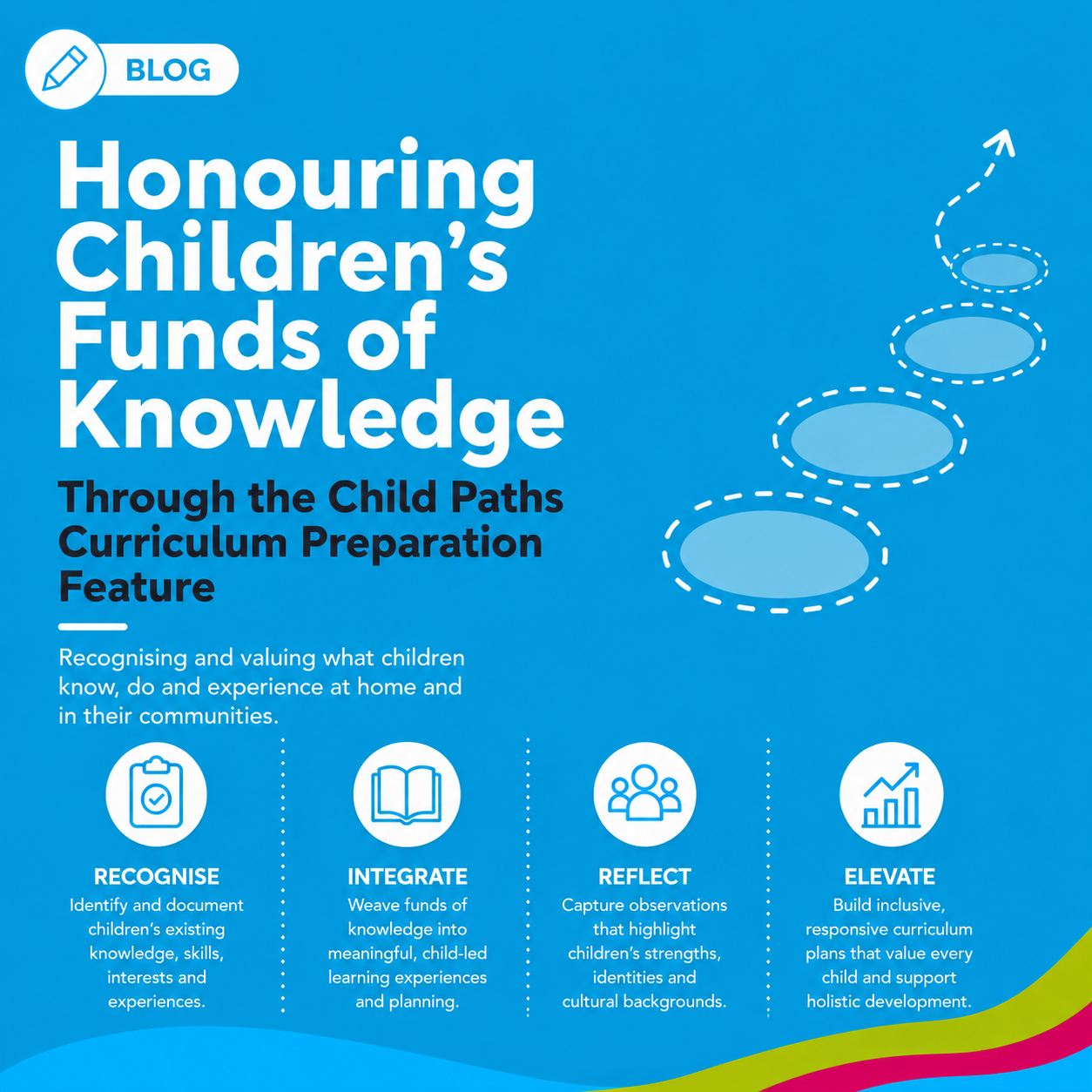
Honouring Children’s Funds of Knowledge Through the Child Paths Curriculum Preparation Feature
In Early Childhood Education and Care (ECEC), curriculum planning is increasingly moving away from pre-determined activities towards a deeper understanding of children’s lived experiences, interests, and identities. As the updated Aistear framework continues to emphasise responsive, rights-based and relational practice, educators are being encouraged to recognise that children arrive into settings already rich in knowledge, experiences, and understandings.
The new Curriculum Preparation feature within Child Paths has been designed with this philosophy at its core. Rather than asking educators simply what activities will be planned, the tool encourages reflection on what babies, toddlers, and young children already know about an emergent or planned interest. In doing so, it supports educators to build curriculum from children’s “funds of knowledge” and “funds of identity.”
Seeing Children as Competent and Knowledgeable
Research consistently highlights that children’s interests emerge from their participation in family and community life. Hedges and colleagues (2011) describe this as a funds of knowledge approach, recognising that all children and families bring valuable experiences, skills, beliefs, and understandings into ECEC settings.
For example, a baby from a passionate GAA family may already have rich experiences connected to sport, attending matches, hearing conversations, wearing jerseys, or playing with hurls and balls at home (French, 2018). These experiences become part of the child’s personalised curriculum long before entering an early years setting.
The Child Paths Curriculum Preparation feature supports educators in identifying and responding to these experiences in meaningful ways. By prompting educators to consider what children already know, the feature encourages curriculum planning that is connected, relevant, and culturally responsive.
This approach shifts curriculum planning from “what will I teach?” to “what matters to this child and how can I build upon it?”
Moving Beyond Activities Towards Meaningful Interests
Too often, children’s interests can be reduced to surface-level topics or activities. However, current research suggests that children’s play choices are deeply connected to their sociocultural experiences and identities.
As Liz Chesworth (2023) explains, children use objects and play experiences to represent the experiences and relationships that matter to them. The interest is not necessarily the toy itself, but the meaning and lived experience behind it.
The Curriculum Preparation feature supports educators in exploring these deeper meanings. Through links to previous curriculum plans and prior learning experiences, educators can trace the continuity of children’s thinking, relationships, fascinations, and inquiries over time.
This creates opportunities for richer, more sustained curriculum journeys rather than isolated activities disconnected from children’s lives.
Supporting Identity, Belonging and Participation
Recent developments in research have expanded the concept of funds of knowledge into funds of identity (Esteban-Guitart & Moll, 2014; Hedges, 2020). This perspective recognises that the experiences children value most strongly contribute to their developing sense of self, belonging, and competence.
The Child Paths feature aligns closely with this thinking by encouraging educators to reflect on children’s emerging identities, relationships, languages, values, and community experiences during curriculum preparation.
Importantly, the feature also supports educators in considering children’s “fundamental inquiries”, i.e. the big questions children explore through play, relationships, and investigation:
- How can I make special connections with people I know?
- How can I understand the world I live in?
- How can I express my creativity?
- What can I do now that I am bigger?
- How can I develop my wellbeing?
These inquiries help educators move beyond narrow themes towards a curriculum that is emotionally meaningful, intellectually engaging, and deeply connected to children’s everyday lives.
Bridging Planned and Lived Curriculum
Curriculum theorist Aoki (1993) described the importance of educators occupying the “middle space” between curriculum as a plan and curriculum as lived experience. This requires educators to genuinely enter into children’s worlds while inviting children into shared processes of meaning-making and reflection.
The Child Paths Curriculum Preparation feature supports this relational process by linking current planning to previous observations, learning records, and experiences. In doing so, educators can see curriculum not as a static document, but as an evolving conversation between children, families, educators, and communities.
Conclusion
The new Child Paths Curriculum Preparation feature offers educators a thoughtful and reflective way to plan curriculum that honours children’s lived experiences, identities, and interests. By foregrounding funds of knowledge and encouraging educators to build from what children already know and care about, the tool supports curriculum that is meaningful, participatory, and deeply connected to children’s worlds.
In this way, curriculum preparation becomes more than planning activities. It becomes a process of listening, noticing, connecting, and co-constructing learning with children at the centre.
References
Aoki, T. (1993) ‘Legitimating lived curriculum: Towards a curricular landscape of multiplicity’, Journal of Curriculum and Supervision, 8(3), pp. 255–268.
Chesworth, L. (2014) ‘A funds of knowledge approach to examining play interests: Listening to children’s and parents’ perspectives’, International Journal of Early Years Education, 22(3), pp. 323–334.
Chesworth, L. (2016) ‘Children’s engagement with popular culture: A funds of knowledge perspective’, Early Years, 36(4), pp. 440–452.
Chesworth, L. (2023) ‘Children’s interests, funds of knowledge and funds of identity in early childhood education’, Early Child Development and Care, 193(5), pp. 721–735.
Chesworth, L. and Hedges, H. (2023) ‘Understanding children’s interests through funds of knowledge, funds of identity and fundamental inquiries’, Contemporary Issues in Early Childhood, 24(2), pp. 145–159.
Dockett, S., Perry, B. and Kearney, E. (2013) Starting School: Perspectives from Australia. Sydney: UNSW Press.
Esteban‐Guitart, M. (2016) Funds of Identity: Connecting Meaningful Learning Experiences in and out of School. Cambridge: Cambridge University Press.
Esteban‐Guitart, M. and Moll, L. (2014) ‘Funds of identity: A new concept based on the funds of knowledge approach’, Culture & Psychology, 20(1), pp. 31–48.
French, G. (2018) Supporting Babies’ and Toddlers’ Learning Through Aistear. Dublin: National Council for Curriculum and Assessment.
Gutiérrez, K. and Rogoff, B. (2003) ‘Cultural ways of learning: Individual traits or repertoires of practice’, Educational Researcher, 32(5), pp. 19–25.
Hedges, H. (2011) ‘Connecting “snამდვილ real life” experiences and interests with learning in early childhood settings’, Australasian Journal of Early Childhood, 36(1), pp. 79–87.
Hedges, H. (2020) Children’s Interests, Inquiries and Identities: Curriculum, Pedagogy, Learning and Outcomes. London: Routledge.
Hedges, H. (2022) ‘Funds of identity in early childhood curriculum and pedagogy’, Curriculum Perspectives, 42(2), pp. 211–220.
Hedges, H., Cullen, J. and Jordan, B. (2011) ‘Early years curriculum: Funds of knowledge as a conceptual framework for children’s interests’, Journal of Curriculum Studies, 43(2), pp. 185–205.
Moll, L., Amanti, C., Neff, D. and Gonzalez, N. (1992) ‘Funds of knowledge for teaching: Using a qualitative approach to connect homes and classrooms’, Theory Into Practice, 31(2), pp. 132–141.
Poole, A. (2017) ‘Young children’s use of digital media and funds of knowledge’, Early Child Development and Care, 187(8), pp. 1213–1225.
In Early Childhood Education and Care (ECEC), curriculum planning is increasingly moving away from pre-determined activities towards a deeper understanding of children’s lived experiences, interests, and identities. As the updated Aistear framework continues to emphasise responsive, rights-based and relational practice, educators are being encouraged to recognise that children arrive into settings already rich in knowledge, experiences, and understandings.
The new Curriculum Preparation feature within Child Paths has been designed with this philosophy at its core. Rather than asking educators simply what activities will be planned, the tool encourages reflection on what babies, toddlers, and young children already know about an emergent or planned interest. In doing so, it supports educators to build curriculum from children’s “funds of knowledge” and “funds of identity.”
Seeing Children as Competent and Knowledgeable
Research consistently highlights that children’s interests emerge from their participation in family and community life. Hedges and colleagues (2011) describe this as a funds of knowledge approach, recognising that all children and families bring valuable experiences, skills, beliefs, and understandings into ECEC settings.
For example, a baby from a passionate GAA family may already have rich experiences connected to sport, attending matches, hearing conversations, wearing jerseys, or playing with hurls and balls at home (French, 2018). These experiences become part of the child’s personalised curriculum long before entering an early years setting.
The Child Paths Curriculum Preparation feature supports educators in identifying and responding to these experiences in meaningful ways. By prompting educators to consider what children already know, the feature encourages curriculum planning that is connected, relevant, and culturally responsive.
This approach shifts curriculum planning from “what will I teach?” to “what matters to this child and how can I build upon it?”
Moving Beyond Activities Towards Meaningful Interests
Too often, children’s interests can be reduced to surface-level topics or activities. However, current research suggests that children’s play choices are deeply connected to their sociocultural experiences and identities.
As Liz Chesworth (2023) explains, children use objects and play experiences to represent the experiences and relationships that matter to them. The interest is not necessarily the toy itself, but the meaning and lived experience behind it.
The Curriculum Preparation feature supports educators in exploring these deeper meanings. Through links to previous curriculum plans and prior learning experiences, educators can trace the continuity of children’s thinking, relationships, fascinations, and inquiries over time.
This creates opportunities for richer, more sustained curriculum journeys rather than isolated activities disconnected from children’s lives.
Supporting Identity, Belonging and Participation
Recent developments in research have expanded the concept of funds of knowledge into funds of identity (Esteban-Guitart & Moll, 2014; Hedges, 2020). This perspective recognises that the experiences children value most strongly contribute to their developing sense of self, belonging, and competence.
The Child Paths feature aligns closely with this thinking by encouraging educators to reflect on children’s emerging identities, relationships, languages, values, and community experiences during curriculum preparation.
Importantly, the feature also supports educators in considering children’s “fundamental inquiries”, i.e. the big questions children explore through play, relationships, and investigation:
- How can I make special connections with people I know?
- How can I understand the world I live in?
- How can I express my creativity?
- What can I do now that I am bigger?
- How can I develop my wellbeing?
These inquiries help educators move beyond narrow themes towards a curriculum that is emotionally meaningful, intellectually engaging, and deeply connected to children’s everyday lives.
Bridging Planned and Lived Curriculum
Curriculum theorist Aoki (1993) described the importance of educators occupying the “middle space” between curriculum as a plan and curriculum as lived experience. This requires educators to genuinely enter into children’s worlds while inviting children into shared processes of meaning-making and reflection.
The Child Paths Curriculum Preparation feature supports this relational process by linking current planning to previous observations, learning records, and experiences. In doing so, educators can see curriculum not as a static document, but as an evolving conversation between children, families, educators, and communities.
Conclusion
The new Child Paths Curriculum Preparation feature offers educators a thoughtful and reflective way to plan curriculum that honours children’s lived experiences, identities, and interests. By foregrounding funds of knowledge and encouraging educators to build from what children already know and care about, the tool supports curriculum that is meaningful, participatory, and deeply connected to children’s worlds.
In this way, curriculum preparation becomes more than planning activities. It becomes a process of listening, noticing, connecting, and co-constructing learning with children at the centre.
References
Aoki, T. (1993) ‘Legitimating lived curriculum: Towards a curricular landscape of multiplicity’, Journal of Curriculum and Supervision, 8(3), pp. 255–268.
Chesworth, L. (2014) ‘A funds of knowledge approach to examining play interests: Listening to children’s and parents’ perspectives’, International Journal of Early Years Education, 22(3), pp. 323–334.
Chesworth, L. (2016) ‘Children’s engagement with popular culture: A funds of knowledge perspective’, Early Years, 36(4), pp. 440–452.
Chesworth, L. (2023) ‘Children’s interests, funds of knowledge and funds of identity in early childhood education’, Early Child Development and Care, 193(5), pp. 721–735.
Chesworth, L. and Hedges, H. (2023) ‘Understanding children’s interests through funds of knowledge, funds of identity and fundamental inquiries’, Contemporary Issues in Early Childhood, 24(2), pp. 145–159.
Dockett, S., Perry, B. and Kearney, E. (2013) Starting School: Perspectives from Australia. Sydney: UNSW Press.
Esteban‐Guitart, M. (2016) Funds of Identity: Connecting Meaningful Learning Experiences in and out of School. Cambridge: Cambridge University Press.
Esteban‐Guitart, M. and Moll, L. (2014) ‘Funds of identity: A new concept based on the funds of knowledge approach’, Culture & Psychology, 20(1), pp. 31–48.
French, G. (2018) Supporting Babies’ and Toddlers’ Learning Through Aistear. Dublin: National Council for Curriculum and Assessment.
Gutiérrez, K. and Rogoff, B. (2003) ‘Cultural ways of learning: Individual traits or repertoires of practice’, Educational Researcher, 32(5), pp. 19–25.
Hedges, H. (2011) ‘Connecting “snამდვილ real life” experiences and interests with learning in early childhood settings’, Australasian Journal of Early Childhood, 36(1), pp. 79–87.
Hedges, H. (2020) Children’s Interests, Inquiries and Identities: Curriculum, Pedagogy, Learning and Outcomes. London: Routledge.
Hedges, H. (2022) ‘Funds of identity in early childhood curriculum and pedagogy’, Curriculum Perspectives, 42(2), pp. 211–220.
Hedges, H., Cullen, J. and Jordan, B. (2011) ‘Early years curriculum: Funds of knowledge as a conceptual framework for children’s interests’, Journal of Curriculum Studies, 43(2), pp. 185–205.
Moll, L., Amanti, C., Neff, D. and Gonzalez, N. (1992) ‘Funds of knowledge for teaching: Using a qualitative approach to connect homes and classrooms’, Theory Into Practice, 31(2), pp. 132–141.
Poole, A. (2017) ‘Young children’s use of digital media and funds of knowledge’, Early Child Development and Care, 187(8), pp. 1213–1225.
- Crobstacle
- August 19, 2026
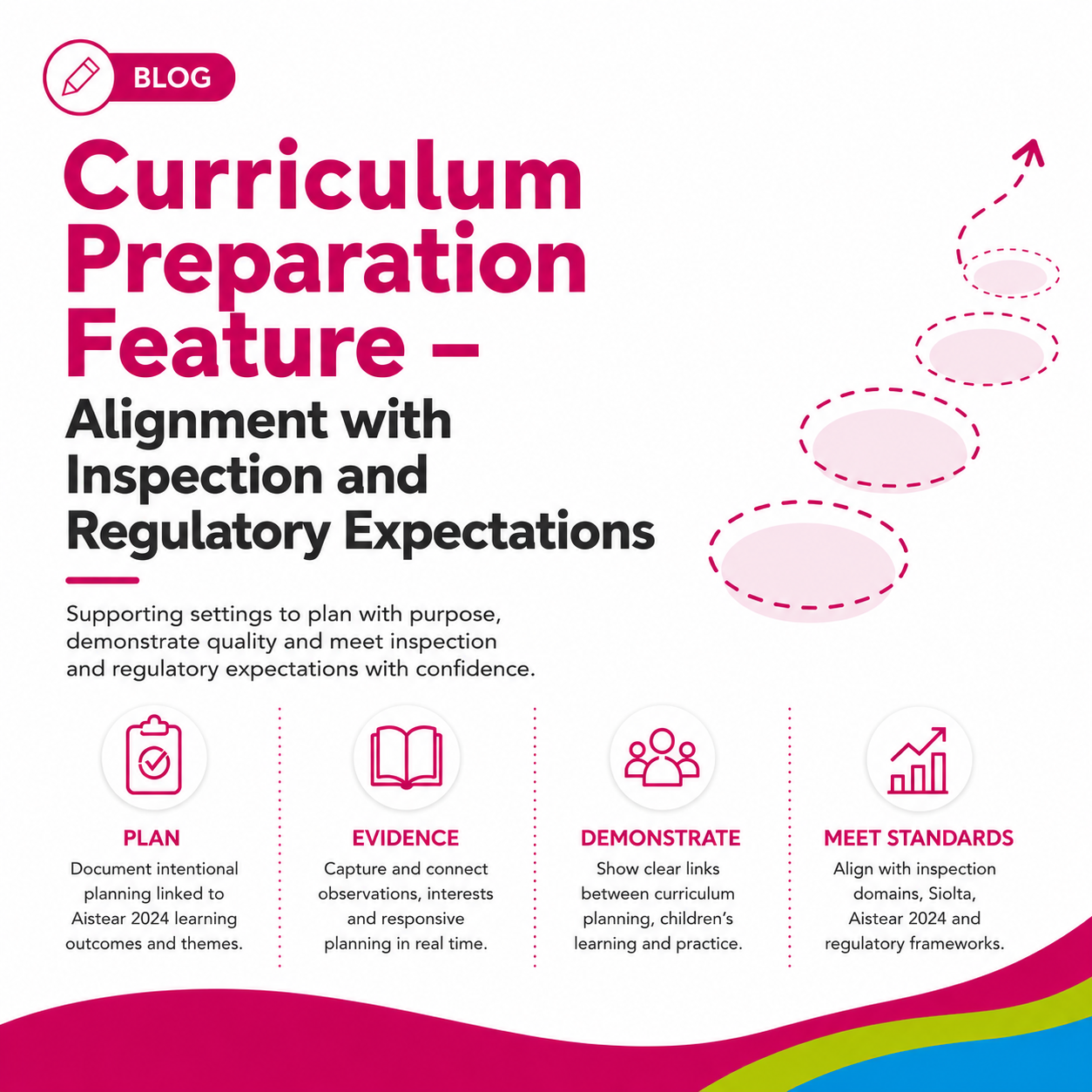
Curriculum Preparation Feature – Alignment with Inspection and Regulatory Expectations
The redevelopment of the Curriculum Preparation feature within Child Paths is intentionally aligned with current inspection frameworks and regulatory expectations, while remaining firmly grounded in high-quality early childhood pedagogy. The revised Aistear framework (NCCA, 2024), Síolta Standards, and Tusla Early Years Inspectorate guidance consistently emphasise intentional planning, continuity of learning, reflective practice, inclusion, and meaningful documentation of children’s learning and development. This feature is designed to support educators to evidence these practices in ways that are authentic, manageable, and pedagogically sound.
Inspection guidance requires that services demonstrate how curriculum planning is informed by observation, assessment, and children’s interests, and how it supports progression over time. Educators are expected to show clear links between planning, implementation, and review, including how learning experiences align with Aistear’s themes, learning outcomes, dispositions, and wellbeing. The revised Child Paths planning feature directly supports this requirement by explicitly connecting the curriculum statement and medium-term preparation within a single, coherent framework. This enables services to demonstrate continuity and progression in learning without imposing rigid or linear planning structures that contradict emergent curriculum principles.
Importantly, inspectors increasingly recognise that high-quality curriculum planning in ECEC is flexible, responsive, and context-specific. Educator feedback highlights that much planning occurs through professional dialogue, observation, and in-the-moment decision-making, rather than through extensive written plans. The Child Paths feature responds to this reality by enabling educators to capture spontaneous planning and professional judgement efficiently, providing proportionate evidence of reflective practice without increasing administrative burden. This aligns with inspection expectations that documentation should be purposeful, manageable, and reflective of everyday practice.
The feature also supports inspection requirements relating to inclusion, equality, and access. By embedding prompts related to children’s individual needs, emergent interests, schemas, dispositions, and funds of knowledge, the planning tool enables services to demonstrate how curriculum provision is differentiated and inclusive, in line with the Access and Inclusion Model (AIM) and anti-bias practice. This supports inspectors’ focus on how settings respond to diversity, promote equity, and ensure that all children can participate meaningfully in the curriculum.
Assessment and documentation elements within the planning feature align with Aistear’s reflective cycle and guidance on observing, recording, and using assessment information to inform next steps. Educators are supported to link planning decisions to observations and learning records, making learning visible while respecting the complexity and non-linear nature of early learning. This provides clear evidence of ongoing assessment, review, and curriculum evaluation, which are key areas of inspection focus.
Family partnership is another central inspection priority. The revised planning feature supports services to demonstrate how parents’ knowledge, perspectives, and contributions inform curriculum decisions, in line with Aistear and Síolta expectations regarding partnership with families. This enables services to evidence communication, collaboration, and shared understanding of children’s learning.
Overall, the Curriculum Preparation feature has been designed to support services to meet inspection and regulatory requirements by strengthening pedagogy rather than diluting it. It enables educators to articulate and evidence high-quality, reflective, child-centred practice in ways that align with inspection language, while remaining faithful to the lived realities of early childhood education and care.
The redevelopment of the Curriculum Preparation feature within Child Paths is intentionally aligned with current inspection frameworks and regulatory expectations, while remaining firmly grounded in high-quality early childhood pedagogy. The revised Aistear framework (NCCA, 2024), Síolta Standards, and Tusla Early Years Inspectorate guidance consistently emphasise intentional planning, continuity of learning, reflective practice, inclusion, and meaningful documentation of children’s learning and development. This feature is designed to support educators to evidence these practices in ways that are authentic, manageable, and pedagogically sound.
Inspection guidance requires that services demonstrate how curriculum planning is informed by observation, assessment, and children’s interests, and how it supports progression over time. Educators are expected to show clear links between planning, implementation, and review, including how learning experiences align with Aistear’s themes, learning outcomes, dispositions, and wellbeing. The revised Child Paths planning feature directly supports this requirement by explicitly connecting the curriculum statement and medium-term preparation within a single, coherent framework. This enables services to demonstrate continuity and progression in learning without imposing rigid or linear planning structures that contradict emergent curriculum principles.
Importantly, inspectors increasingly recognise that high-quality curriculum planning in ECEC is flexible, responsive, and context-specific. Educator feedback highlights that much planning occurs through professional dialogue, observation, and in-the-moment decision-making, rather than through extensive written plans. The Child Paths feature responds to this reality by enabling educators to capture spontaneous planning and professional judgement efficiently, providing proportionate evidence of reflective practice without increasing administrative burden. This aligns with inspection expectations that documentation should be purposeful, manageable, and reflective of everyday practice.
The feature also supports inspection requirements relating to inclusion, equality, and access. By embedding prompts related to children’s individual needs, emergent interests, schemas, dispositions, and funds of knowledge, the planning tool enables services to demonstrate how curriculum provision is differentiated and inclusive, in line with the Access and Inclusion Model (AIM) and anti-bias practice. This supports inspectors’ focus on how settings respond to diversity, promote equity, and ensure that all children can participate meaningfully in the curriculum.
Assessment and documentation elements within the planning feature align with Aistear’s reflective cycle and guidance on observing, recording, and using assessment information to inform next steps. Educators are supported to link planning decisions to observations and learning records, making learning visible while respecting the complexity and non-linear nature of early learning. This provides clear evidence of ongoing assessment, review, and curriculum evaluation, which are key areas of inspection focus.
Family partnership is another central inspection priority. The revised planning feature supports services to demonstrate how parents’ knowledge, perspectives, and contributions inform curriculum decisions, in line with Aistear and Síolta expectations regarding partnership with families. This enables services to evidence communication, collaboration, and shared understanding of children’s learning.
Overall, the Curriculum Preparation feature has been designed to support services to meet inspection and regulatory requirements by strengthening pedagogy rather than diluting it. It enables educators to articulate and evidence high-quality, reflective, child-centred practice in ways that align with inspection language, while remaining faithful to the lived realities of early childhood education and care.
- Crobstacle
- August 11, 2026
What does democracy look like in a post-digital early childhood world?
Reflections from the 34th European Early Childhood Education Research Association Conference, Madeira, August 2026
Dr Gillian Lake, Chief Education Officer, Child Paths; EECERA Trustee
I was fortunate enough to attend the 34th European Early Childhood Education Research Association (EECERA) Conference this year on the beautiful and tropical island of Madeira. What an experience that was.
My work as an EECERA Trustee is only getting started, and I feel incredibly fortunate to be able to sit alongside colleagues from across the world and listen to the wonderful stories of research being undertaken in early childhood. Ireland, New Zealand, Hungary, Spain, Australia, Turkey, Portugal and many other countries were represented among the near 800 delegates, creating a rich tapestry of research approaches, perspectives and cultural nuances.
And then there was Madeira.
The warmth of the island, the warmth of its people and the warmth of the conversations made for a very memorable few days.
But it was the conference theme, democracy and participation in early childhood education, that stayed with me most strongly. It could hardly have been more relevant.
In her presidential address, our EECERA President, Professor Chris Pascal, spoke eloquently about the shifting and challenging world of what she described as polycrises. We are living through considerable social, political and technological change, and early childhood does not sit outside of that. Quite the opposite. Our youngest children are growing up in a world where the boundaries between digital and non-digital life are increasingly difficult to distinguish.
So, what does democracy and participation mean for young children in a post-digital world?
That question followed me throughout the conference.
Technology, participation and the child
Professor Suzy Edwards’ keynote gave us much to think about. She challenged us to investigate the philosophy of technology, rather than simply thinking about technology as a collection of tools that we choose to use or not use.One of the most delightful examples she shared came from her research into digital literacy through play using unplugged technology artefacts. Children played with wooden versions of familiar technological objects, including mobile phones. One child carried a wooden phone pressed against their upper chest, while several others repeatedly checked the charging status throughout the day. These beautiful little vignettes showed children drawing on their understandings of technology and incorporating them into their play, relationships and meaning making.
Professor Edwards asked us to consider how we can advance democracy for children in a post-digital world. The idea of critical constructivism particularly resonated with me and with it, the notion that our values need to be considered within the design of technology itself.
This is an important challenge for anyone designing digital tools for educators. Technology is never entirely neutral. What we make visible, what we make easy, what we ask educators to record and what we leave space for all carry values.
The opportunity is to design technology that supports professional agency rather than replacing it. Tools can provide possibilities, connections and prompts, while educators remain the people making the professional decisions.
And that same principle of agency was echoed throughout the conference.
One study exploring children’s participation reminded us that participation does not always look loud. The child running, shouting and actively communicating is participating, but so too is the child watching carefully from the edge, listening, quietly constructing or taking the time to work out what they want to say. If we are to understand children’s participation, we need to stop and really look and listen with our eyes.
That has implications not just for how we observe children, but for how we design environments, curriculum and the systems we use to document learning. If we only capture what is easily visible or measurable, we risk creating a very narrow picture of children’s agency.
Another study explored children’s agency during shared book reading and demonstrated how actively children use illustrations to communicate, interpret and make sense of stories. It was a lovely reminder that the whole book is an opportunity for participation, not simply the words on the page.
I was also struck by research examining the phrase “best interests of the child.” It is a phrase we use constantly and indeed is represented in worldwide documents including the UNCRC. Yet there is no single shared definition of what it means. Often, children’s best interests are defined from an adult or professional perspective.
But what do children themselves believe is in their best interests?
That simple question challenges us to think differently about power. If we genuinely believe in participation, perhaps we need to become more comfortable with making decisions with children rather than simply for them.Reema Patel’s keynote reinforced this beautifully through the idea of “nothing about them without them.” Her work on activating agency with Elgon Social Research made us think about the role adults play in creating the conditions for participation, and whether technology can enhance children’s life chances rather than simply becoming another mechanism for managing risk.
And then came Professor Julia Forminsho, our own EECERA Trustee and a personal hero of mine.
Julia spoke with such care about pedagogy and participation, reminding us that democracy begins with us. Before we can genuinely enable children’s participation, we need to examine our own mindsets.
Her emphasis on “we-ness” and on creating space for voice and time, what she described as ethical suspension, really stayed with me. We need to allow children’s curiosity, questioning and intuition to develop.
The response from the room said everything. A spontaneous standing ovation followed her keynote. It felt like a moment of collective recognition.
What might we take forward?
Across the conference, I kept returning to one central idea: real participation requires a shift in power.
For educators, this means questioning our assumptions about what participation looks like and becoming better at noticing the quieter, less immediately visible ways children communicate.
For researchers, it means continuing to ask whose voices are represented and whose are missing.
For those designing technology for educators, it means thinking carefully about the values embedded within our systems. Digital tools can make things easier, but they can also shape what we notice, what we record and what we consider important.
Perhaps our ambition should be technology that helps educators listen more deeply, respond more flexibly and exercise their professional judgement.
Technology should not close possibilities. It should open them up.
I also attended sessions exploring folk tales and children’s wellbeing, reviews of ECERS, STEAM in early childhood and the challenges of supporting indigenous languages in early literacy. The breadth of the research was extraordinary and once again reminded me that early childhood education cannot be separated from questions of identity, culture, language, wellbeing, relationships and society.
We also heard about the realities facing the early childhood workforce in Ireland, including staff turnover of 22.4%, with pay and conditions continuing to create significant challenges. It was striking to hear similar concerns echoed across many of the countries represented.
And then there was Madeira itself.
The wonderful APEI team who organised the conference on the ground. The taxi drivers greeting us with a smile as they navigated the many hills of Funchal. The sunset boat trip, complete with dolphins and whales frolicking alongside us. The lights of the houses scattered across the hillside as we sailed back into Funchal.
And, thankfully, the little fan in our conference bags, which became one of my most treasured possessions in the Madeira heat!
Leaving Madeira
Perhaps my biggest takeaway was not a particular paper, model or presentation. It was a renewed belief in the importance of real participation.
Laura Lundy’s model continues to provide such a valuable foundation for thinking about children’s participation, and it was wonderful to see it underpinning so much of the research being presented.
The friendships made and maintained over those few days were just as important as the formal programme. Conferences such as EECERA remind me that research is not something that happens in isolation. It is a conversation that crosses countries, cultures, disciplines and perspectives.
I left Madeira feeling energised.
Energised by the research.
Energised by the conversations.
Energised by the friendships.
And energised by the responsibility we have to continue advocating for, researching with and engaging meaningfully with early childhood education.
The question of democracy is not going away. Nor should it.
If anything, as our world becomes more complex and more digital, our commitment to children’s voice, agency and participation needs to become stronger.
We need to keep asking:
Who gets to decide?
Whose voice are we hearing?
What are we overlooking?
And perhaps most importantly:
What would happen if we trusted children a little more?
There is much work to do.
And I am very glad to be part of it.
Bring on Zagreb EECERA 2027!
- Crobstacle
- September 11, 2026
From Principles to Practice: How the Revised Curriculum Preparation Feature Supports Inclusive, Rights-Based Early Learning
As the revised early childhood curriculum framework Aistear is implemented in Ireland, many educators are asking the same question: What does this look like in everyday practice? While the revised curriculum introduces important developments around children’s rights, inclusion and participation, its greatest strength lies not in presenting new ideas, but in deepening our understanding of what quality practice already aspires to be.
This is where the revised Child Paths Curriculum Preparation Featureoffers timely and practical support. Rather than presenting inclusion as another initiative to add to an already busy day, the feature invites educators to reflect on the environments, relationships and interactions they create for children every day. It encourages us to move beyond asking whether children are present in our settings to considering whether every child genuinely experiences belonging, participation and influence.
Central to this reflection is the updated Lundy Model of Participation (2007; 2024). While many educators are familiar with children’s voice, the feature explores participation in its fullest sense through Lundy’s four interconnected elements: Space, Voice, Audience and Influence. The reflective questions woven throughout the feature encourage educators to pause and consider their own practice. How do children know they are safe to express their ideas? Have we allowed enough time to truly listen? How do we ensure that children who communicate in different ways are heard? Are we genuinely ready to listen, and do children understand what happens after they share their views? Perhaps most importantly, how do children see that their ideas have influenced decisions? These questions move participation beyond consultation towards authentic rights-based practice. They remind us that listening is not an event but an ongoing professional disposition.
Drawing on the work of Ainscow (2020), Pantić and Florian (2015), and Graham et al. (2025), the Child Paths curriculum preparation feature asks educators to design learning experiences that anticipate learner diversity from the outset rather than adapting them afterwards. These ideas resonate strongly with Universal Design for Learning, shifting our thinking from differentiation for some children to accessible learning for everyone.
Perhaps one of the greatest strengths of the preparation feature is that it does not provide a checklist of strategies. Instead, it supports professional inquiry. Its reflective prompts encourage educators to think deeply about their own settings, their interactions and the everyday decisions that shape children’s experiences of inclusion and participation.
Ultimately, curriculum preparation is about looking more closely at our existing practice through the lens of children’s rights. The preparation feature helps educators translate ambitious curriculum aspirations into meaningful experiences for every child. In doing so, it reminds us that inclusion is not something we add to the curriculum, it is the way the curriculum comes alive.
The Child Paths curriculum preparation feature is designed to support educators in engaging with these ideas through reflective questions, research-informed insights and practical connections to everyday practice, making it a valuable resource as settings assimilate Aistear 2024.
References
Ainscow, M. (2020). Promoting inclusion and equity in education: Lessons from international experiences. Nordic Journal of Studies in Educational Policy, 6(1), 7–16.
Botha, M., Hanlon, J., & Williams, G. L. (2024). Research and practice in neurodiversity-affirming approaches. (or another neurodiversity-affirming source you are already using).
Department of Children, Equality, Disability, Integration and Youth. (2022). Access and Inclusion Model (AIM). https://aim.gov.ie
Department of Education. (2024). Literacy, Numeracy and Digital Literacy Strategy 2024–2033. Dublin: Government of Ireland.
Florian, L., & Black-Hawkins, K. (2011). Exploring inclusive pedagogy. British Educational Research Journal, 37(5), 813–828.
Lundy, L. (2007). ‘Voice’ is not enough: Conceptualising Article 12 of the United Nations Convention on the Rights of the Child. British Educational Research Journal, 33(6), 927–942.
Lundy, L. (2024). The Lundy Model of Participation: Guidance and updated resources. Queen’s University Belfast.
Pantić, N., & Florian, L. (2015). Developing teachers as agents of inclusion and social justice. Education Inquiry, 6(3), 333–351.
Pellicano, E., & den Houting, J. (2022). Annual Research Review: Shifting from ‘normal science’ to neurodiversity in autism science. Journal of Child Psychology and Psychiatry.
United Nations. (1989). United Nations Convention on the Rights of the Child. New York: United Nations.
United Nations. (2006). Convention on the Rights of Persons with Disabilities (CRPD). New York: United Nations.
- Crobstacle
- August 25, 2026
Writing Meaningful Learning Outcomes with the Child Paths Curriculum Preparation Feature
As curriculum planning becomes increasingly reflective and child-centred within Early Childhood Education and Care (ECEC), writing meaningful learning outcomes is an important part of the planning process. The new Curriculum Preparation feature within Child Paths supports educators in developing learning outcomes that are responsive, realistic, and connected to children’s prior learning and emerging interests.
According to the National Council for Curriculum and Assessment (NCCA), learning outcomes describe the knowledge, understanding, skills, and values children should be able to demonstrate after a period of learning. Importantly, they are not simply activity goals. Instead, they focus on children’s developing concepts, dispositions, skills, and attitudes across a range of contexts.
So, how can educators write meaningful learning outcomes?
1. Start with the child
The Child Paths Curriculum Preparation feature encourages educators to reflect on children’s existing knowledge, interests, and experiences before planning. Using observations, previous curriculum plans, and learning records helps educators identify realistic and relevant next steps for learning.
2. Focus on learning, not activities
Rather than writing outcomes based on what children will do, focus on what children may learn, understand, explore, or develop. For example:
- Instead of: Children will paint autumn trees
- Consider: Children will explore colour, texture, and seasonal change through creative expression.
This shift supports deeper and more transferable learning.
3. Think holistically
Learning outcomes should reflect the whole child. Effective outcomes often combine concepts, skills, dispositions, wellbeing, communication, creativity, and relationships rather than focusing on isolated knowledge.
4. Allow flexibility
The NCCA reminds educators that all children learn differently and that learning journeys will vary across contexts. The Child Paths feature supports this by allowing educators to revisit and adapt outcomes as children’s interests evolve over time.
5. Connect outcomes to everyday practice
Meaningful learning outcomes become visible through play, routines, interactions, conversations, and experiences. The Curriculum Preparation feature supports educators in linking learning outcomes with assessment practices, previous planning, and future curriculum decisions.
Ultimately, writing learning outcomes is not about predicting exactly what children will achieve. It is about thoughtfully identifying possibilities for learning while remaining responsive to children’s voices, interests, and developing identities.
References
National Council for Curriculum and Assessment (2019) Learning Outcomes: A Guide for Practitioners. Dublin: NCCA.
National Council for Curriculum and Assessment (2020) Preparation for Teaching and Learning: Guidance for Primary and Early Years Educators. Dublin: NCCA.
- Crobstacle
- August 25, 2026
Honouring Children’s Funds of Knowledge Through the Child Paths Curriculum Preparation Feature
In Early Childhood Education and Care (ECEC), curriculum planning is increasingly moving away from pre-determined activities towards a deeper understanding of children’s lived experiences, interests, and identities. As the updated Aistear framework continues to emphasise responsive, rights-based and relational practice, educators are being encouraged to recognise that children arrive into settings already rich in knowledge, experiences, and understandings.
The new Curriculum Preparation feature within Child Paths has been designed with this philosophy at its core. Rather than asking educators simply what activities will be planned, the tool encourages reflection on what babies, toddlers, and young children already know about an emergent or planned interest. In doing so, it supports educators to build curriculum from children’s “funds of knowledge” and “funds of identity.”
Seeing Children as Competent and Knowledgeable
Research consistently highlights that children’s interests emerge from their participation in family and community life. Hedges and colleagues (2011) describe this as a funds of knowledge approach, recognising that all children and families bring valuable experiences, skills, beliefs, and understandings into ECEC settings.
For example, a baby from a passionate GAA family may already have rich experiences connected to sport, attending matches, hearing conversations, wearing jerseys, or playing with hurls and balls at home (French, 2018). These experiences become part of the child’s personalised curriculum long before entering an early years setting.
The Child Paths Curriculum Preparation feature supports educators in identifying and responding to these experiences in meaningful ways. By prompting educators to consider what children already know, the feature encourages curriculum planning that is connected, relevant, and culturally responsive.
This approach shifts curriculum planning from “what will I teach?” to “what matters to this child and how can I build upon it?”
Moving Beyond Activities Towards Meaningful Interests
Too often, children’s interests can be reduced to surface-level topics or activities. However, current research suggests that children’s play choices are deeply connected to their sociocultural experiences and identities.
As Liz Chesworth (2023) explains, children use objects and play experiences to represent the experiences and relationships that matter to them. The interest is not necessarily the toy itself, but the meaning and lived experience behind it.
The Curriculum Preparation feature supports educators in exploring these deeper meanings. Through links to previous curriculum plans and prior learning experiences, educators can trace the continuity of children’s thinking, relationships, fascinations, and inquiries over time.
This creates opportunities for richer, more sustained curriculum journeys rather than isolated activities disconnected from children’s lives.
Supporting Identity, Belonging and Participation
Recent developments in research have expanded the concept of funds of knowledge into funds of identity (Esteban-Guitart & Moll, 2014; Hedges, 2020). This perspective recognises that the experiences children value most strongly contribute to their developing sense of self, belonging, and competence.
The Child Paths feature aligns closely with this thinking by encouraging educators to reflect on children’s emerging identities, relationships, languages, values, and community experiences during curriculum preparation.
Importantly, the feature also supports educators in considering children’s “fundamental inquiries”, i.e. the big questions children explore through play, relationships, and investigation:
- How can I make special connections with people I know?
- How can I understand the world I live in?
- How can I express my creativity?
- What can I do now that I am bigger?
- How can I develop my wellbeing?
These inquiries help educators move beyond narrow themes towards a curriculum that is emotionally meaningful, intellectually engaging, and deeply connected to children’s everyday lives.
Bridging Planned and Lived Curriculum
Curriculum theorist Aoki (1993) described the importance of educators occupying the “middle space” between curriculum as a plan and curriculum as lived experience. This requires educators to genuinely enter into children’s worlds while inviting children into shared processes of meaning-making and reflection.
The Child Paths Curriculum Preparation feature supports this relational process by linking current planning to previous observations, learning records, and experiences. In doing so, educators can see curriculum not as a static document, but as an evolving conversation between children, families, educators, and communities.
Conclusion
The new Child Paths Curriculum Preparation feature offers educators a thoughtful and reflective way to plan curriculum that honours children’s lived experiences, identities, and interests. By foregrounding funds of knowledge and encouraging educators to build from what children already know and care about, the tool supports curriculum that is meaningful, participatory, and deeply connected to children’s worlds.
In this way, curriculum preparation becomes more than planning activities. It becomes a process of listening, noticing, connecting, and co-constructing learning with children at the centre.
References
Aoki, T. (1993) ‘Legitimating lived curriculum: Towards a curricular landscape of multiplicity’, Journal of Curriculum and Supervision, 8(3), pp. 255–268.
Chesworth, L. (2014) ‘A funds of knowledge approach to examining play interests: Listening to children’s and parents’ perspectives’, International Journal of Early Years Education, 22(3), pp. 323–334.
Chesworth, L. (2016) ‘Children’s engagement with popular culture: A funds of knowledge perspective’, Early Years, 36(4), pp. 440–452.
Chesworth, L. (2023) ‘Children’s interests, funds of knowledge and funds of identity in early childhood education’, Early Child Development and Care, 193(5), pp. 721–735.
Chesworth, L. and Hedges, H. (2023) ‘Understanding children’s interests through funds of knowledge, funds of identity and fundamental inquiries’, Contemporary Issues in Early Childhood, 24(2), pp. 145–159.
Dockett, S., Perry, B. and Kearney, E. (2013) Starting School: Perspectives from Australia. Sydney: UNSW Press.
Esteban‐Guitart, M. (2016) Funds of Identity: Connecting Meaningful Learning Experiences in and out of School. Cambridge: Cambridge University Press.
Esteban‐Guitart, M. and Moll, L. (2014) ‘Funds of identity: A new concept based on the funds of knowledge approach’, Culture & Psychology, 20(1), pp. 31–48.
French, G. (2018) Supporting Babies’ and Toddlers’ Learning Through Aistear. Dublin: National Council for Curriculum and Assessment.
Gutiérrez, K. and Rogoff, B. (2003) ‘Cultural ways of learning: Individual traits or repertoires of practice’, Educational Researcher, 32(5), pp. 19–25.
Hedges, H. (2011) ‘Connecting “snამდვილ real life” experiences and interests with learning in early childhood settings’, Australasian Journal of Early Childhood, 36(1), pp. 79–87.
Hedges, H. (2020) Children’s Interests, Inquiries and Identities: Curriculum, Pedagogy, Learning and Outcomes. London: Routledge.
Hedges, H. (2022) ‘Funds of identity in early childhood curriculum and pedagogy’, Curriculum Perspectives, 42(2), pp. 211–220.
Hedges, H., Cullen, J. and Jordan, B. (2011) ‘Early years curriculum: Funds of knowledge as a conceptual framework for children’s interests’, Journal of Curriculum Studies, 43(2), pp. 185–205.
Moll, L., Amanti, C., Neff, D. and Gonzalez, N. (1992) ‘Funds of knowledge for teaching: Using a qualitative approach to connect homes and classrooms’, Theory Into Practice, 31(2), pp. 132–141.
Poole, A. (2017) ‘Young children’s use of digital media and funds of knowledge’, Early Child Development and Care, 187(8), pp. 1213–1225.
- Crobstacle
- August 19, 2026
Curriculum Preparation Feature – Alignment with Inspection and Regulatory Expectations
The redevelopment of the Curriculum Preparation feature within Child Paths is intentionally aligned with current inspection frameworks and regulatory expectations, while remaining firmly grounded in high-quality early childhood pedagogy. The revised Aistear framework (NCCA, 2024), Síolta Standards, and Tusla Early Years Inspectorate guidance consistently emphasise intentional planning, continuity of learning, reflective practice, inclusion, and meaningful documentation of children’s learning and development. This feature is designed to support educators to evidence these practices in ways that are authentic, manageable, and pedagogically sound.
Inspection guidance requires that services demonstrate how curriculum planning is informed by observation, assessment, and children’s interests, and how it supports progression over time. Educators are expected to show clear links between planning, implementation, and review, including how learning experiences align with Aistear’s themes, learning outcomes, dispositions, and wellbeing. The revised Child Paths planning feature directly supports this requirement by explicitly connecting the curriculum statement and medium-term preparation within a single, coherent framework. This enables services to demonstrate continuity and progression in learning without imposing rigid or linear planning structures that contradict emergent curriculum principles.
Importantly, inspectors increasingly recognise that high-quality curriculum planning in ECEC is flexible, responsive, and context-specific. Educator feedback highlights that much planning occurs through professional dialogue, observation, and in-the-moment decision-making, rather than through extensive written plans. The Child Paths feature responds to this reality by enabling educators to capture spontaneous planning and professional judgement efficiently, providing proportionate evidence of reflective practice without increasing administrative burden. This aligns with inspection expectations that documentation should be purposeful, manageable, and reflective of everyday practice.
The feature also supports inspection requirements relating to inclusion, equality, and access. By embedding prompts related to children’s individual needs, emergent interests, schemas, dispositions, and funds of knowledge, the planning tool enables services to demonstrate how curriculum provision is differentiated and inclusive, in line with the Access and Inclusion Model (AIM) and anti-bias practice. This supports inspectors’ focus on how settings respond to diversity, promote equity, and ensure that all children can participate meaningfully in the curriculum.
Assessment and documentation elements within the planning feature align with Aistear’s reflective cycle and guidance on observing, recording, and using assessment information to inform next steps. Educators are supported to link planning decisions to observations and learning records, making learning visible while respecting the complexity and non-linear nature of early learning. This provides clear evidence of ongoing assessment, review, and curriculum evaluation, which are key areas of inspection focus.
Family partnership is another central inspection priority. The revised planning feature supports services to demonstrate how parents’ knowledge, perspectives, and contributions inform curriculum decisions, in line with Aistear and Síolta expectations regarding partnership with families. This enables services to evidence communication, collaboration, and shared understanding of children’s learning.
Overall, the Curriculum Preparation feature has been designed to support services to meet inspection and regulatory requirements by strengthening pedagogy rather than diluting it. It enables educators to articulate and evidence high-quality, reflective, child-centred practice in ways that align with inspection language, while remaining faithful to the lived realities of early childhood education and care.
- Crobstacle
- August 11, 2026
Why We’ve Reinvested €5 Million in People, Not Just Software.
For over 12 years, I’ve had the privilege of building Child Paths into Ireland’s leading early years platform alongside an incredible team. What started with a simple idea has grown into a platform trusted by more than 100,000 educators, managers, owners and families across Ireland. During that time, I’ve visited hundreds of early years services, listened to educators, owners and managers, and had the privilege of sitting on boards and working alongside sector leaders. Those experiences have given me a unique insight into the challenges the sector faces every day, from compliance and inspections to staffing shortages, funding pressures and increasing expectations. Those conversations haven’t just influenced our product roadmap. They’ve shaped who we are as a company.
Over the past decade, Child Paths has reinvested more than €5 million back into the business. That investment hasn’t simply been about building software. It’s been about building a company that genuinely understands and supports the people working in early years. Child Paths has been bootstrapped from day one. Every improvement we’ve made, every team member we’ve hired and every innovation we’ve introduced has been funded through the trust our customers place in us. Rather than extracting profits, we’ve continually reinvested them back into the business to create better technology, stronger support and greater value for the early years sector.
Technology has transformed the sector, and AI and automation will continue to play an increasingly important role. They help reduce administration, improve efficiency and give educators more time to focus on children. But early years is, and always will be, a people profession. Sometimes you don’t need another help article or chatbot. You need to speak to someone who understands the pressure of an upcoming inspection, the complexities of Core Funding and NCS, the challenge of recruiting staff, or the day-to-day reality of managing a busy service. That’s why we’ve invested just as heavily in people as we have in technology. Every Child Paths customer is supported by a dedicated Customer Success Manager who gets to know their service, understands their goals and is there to help them succeed. Our team provides onboarding, training and ongoing guidance, working alongside providers as their needs evolve. We believe support should be proactive, personal and built on relationships, not just support tickets, so you have access to different people to support you when you need help.
We’ve also invested in educational expertise, bringing together experienced professionals who understand curriculum, compliance and best practice. Their knowledge helps shape our platform and ensures that what we build reflects the realities of the sector, not assumptions made from behind a desk. Looking ahead, we’re taking that commitment even further through initiatives such as Elevate. Our vision is to go beyond software by providing professional learning, practical resources, specialist training and educational expertise that help services continue to grow. We want Child Paths to be more than a platform. We want it to be a trusted partner throughout every stage of a provider’s journey.
When I look at the software industry, many businesses are built around scale and automation. While those things have their place, we’ve chosen a different path. We believe technology should enhance relationships, not replace them. That’s why our customers can always speak to someone who understands their world and is genuinely invested in helping them succeed. I’m incredibly proud that more than 90% of the services that choose Child Paths continue to use our platform year after year. That loyalty is something we never take for granted. It’s earned through trust, consistency and the commitment of an exceptional team that cares deeply about the work they do.
Looking back on the past 12 years, I’m proud of what we’ve built together. But I’m even more excited about what comes next. We’ll continue investing in our technology, our people and the wider early years sector because that’s always been our mission. Child Paths has never been just about building software. It’s about giving early years providers and families the technology, expertise and support they need to focus on what matters most: delivering the very best outcomes for children and families. Thank you to every educator, owner, manager and family who has been part of our journey so far. Your trust continues to inspire us to keep investing, keep innovating and keep supporting the sector we care so much about.
- Ciaran Flynn
- August 4, 2026
Beyond Professional Development: Why Irish EarlyChildhood Education Needs a New ConversationAbout Professional Learning
The publication of the updated Aistear (2024) marks an important moment in the evolution of Early Childhood Education and Care (ECEC) in Ireland. More than a revised curriculum framework, it reaffirms a vision of educators as agentic, reflective and competent professionals who exercise professional judgement through meaningful relationships with children, families and communities.
Yet curriculum frameworks alone do not transform practice. International evidence consistently reminds us that the greatest determinant of quality in ECEC is not simply the curriculum that is written, but the knowledge, confidence and professional agency of those who bring it to life. The latest findings from the OECD TALIS Starting Strong 2024 study reinforce this message,
highlighting that educators thrive when professional learning is continuous, collaborative and supported by strong pedagogical leadership. At the same time, the report identifies workforce wellbeing, professional recognition and retention as enduring challenges across participating countries. These findings present both an opportunity and a responsibility for the Irish sector.
For many years, professional development has often been understood as attendance at courses or workshops. While these undoubtedly have value, contemporary research suggests they are rarely sufficient to create lasting improvements in practice. Formosinho and colleagues (Formosinho et al., 2024), argues instead for a conception of professional learning that is
relational, inquiry-based and embedded within educators’ everyday experiences. Professional growth occurs not through the transmission of knowledge, but through critical reflection, collaborative dialogue and ethical engagement with practice.
This represents a significant shift in how we think about quality. Quality is not something we inspect into settings. Nor is it achieved solely through regulation or compliance. Rather, quality emerges through professional cultures that encourage reflection, curiosity, shared learning and continuous improvement. It is built when educators are trusted as professionals and supported
to make thoughtful pedagogical decisions informed by research, observation and the unique context of their setting. This understanding has shaped the development of Elevate, by Child Paths .
Elevate has been established as the professional learning, quality improvement and innovation division of Child Paths, founded on a simple belief: quality for children begins with empowered professionals.
Our work is organised around three interconnected pillars.
Elevate Learning supports educators and leaders through professional learning that is practical, flexible and grounded in evidence-informed practice. Whether engaging with Aistear in practice, curriculum planning, reflective practice, leadership or professional identity, the emphasis is on learning that strengthens confidence and informs everyday decision-making rather than adding to professional burden.
Elevate Quality reflects a developmental approach to improvement. Through quality observations, internationally recognised assessment frameworks including ECERS-3 and ECQRS-EC, reflective leadership coaching and strategic consultancy, we work alongside settings to recognise strengths, support critical reflection and build sustainable cultures of quality. Improvement should never be about identifying faults; it should be about creating the conditions in which educators, children and families flourish.
Our third pillar, Elevate Future, recognises that strengthening the profession begins long before an educator enters the workforce. Through our partnership with Further Education providers, learners engage with authentic curriculum planning, digital documentation, reflective observation and quality processes, helping to bridge the gap between initial education and professional practice while fostering confidence and professional identity.
Innovation is equally important. Technology should support educators rather than distract from pedagogy. By developing integrated curriculum planning tools and reflective documentation systems, our ambition is to reduce administrative burden and create more time for meaningful interactions with children.
The updated Aistear invites educators to embrace reflection, responsiveness and professional agency. The challenge before us is ensuring that the systems surrounding educators enable them to realise that vision. Professional learning cannot be episodic. Quality improvement cannot be compliance driven. Innovation cannot be pursued for its own sake. Each must
contribute to a coherent culture of learning that values educators as knowledgeable professionals and invests in their continued growth.
Child Paths Elevate has been created as a contribution to that culture. As a researcher, educator and Chief Education Officer, I remain convinced that the future of Irish ECEC will be shaped not only by policy reform, but by the extent to which we invest in the people who enact that policy every day. Stronger evidence leads to stronger practice. Stronger practice creates richer learning experiences. And ultimately, it is children who benefit when educators are trusted, supported and empowered to continue learning throughout their professional lives.
References
Formosinho, J., Pascal, C., Bertram, T., & Oliveira-Formosinho, J. (2024). Professional Development for Ethical Practice Transformation. European Early Childhood Education Research Journal, 32(6).
Machado, I., & Oliveira-Formosinho, J. (2024). Professional development for praxis transformation in early childhood education and care: A systematic review. European Early Childhood Education Research Journal, 32(6).
National Council for Curriculum and Assessment. (2024). Aistear: The Early Childhood Curriculum Framework. Dublin: NCCA.
OECD. (2025). Results from TALIS Starting Strong 2024. Paris: OECD Publishing.
- Crobstacle
- July 31, 2026
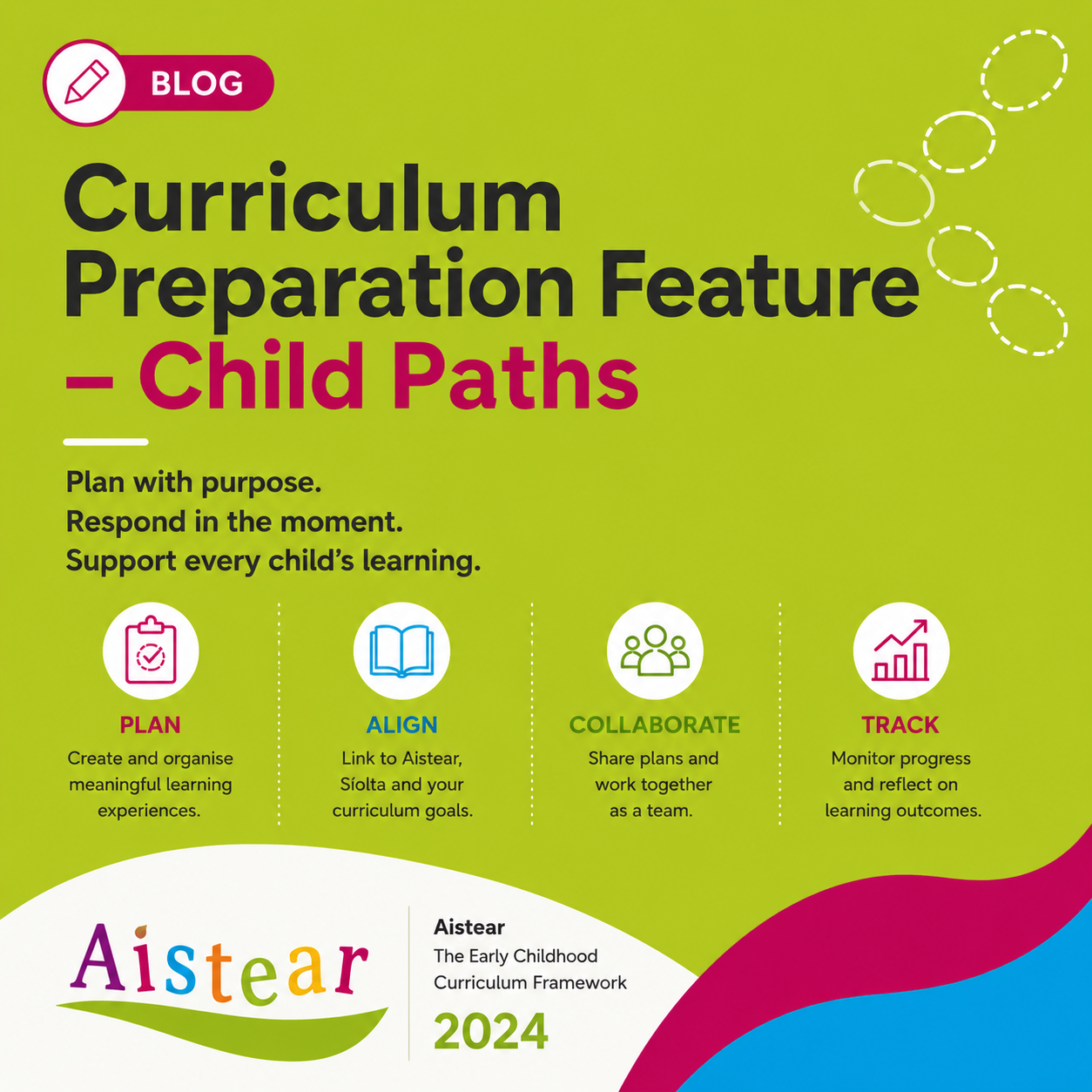
Curriculum Preparation Feature – Child Paths
The development of the Curriculum Preparation feature within Child Paths forms part of a wider programme of work aligned with the updating of Aistear: The Early Childhood Curriculum Framework (NCCA, 2024). The revision of Aistear represents a significant shift towards agentic learning, emergent curriculum, reflective practice, inclusion, and partnership with families. These developments necessitated a review of several Child Paths features to ensure continued alignment with current pedagogy, policy expectations, and educator workflows.
The existing curriculum planning tools within Child Paths were originally developed in the context of Aistear (2009) and had not undergone substantive revision for over ten years. During this period, the early childhood education and care (ECEC) sector has evolved considerably in terms of professional learning, research evidence, inspection expectations, and the realities of practice in increasingly complex settings. Feedback from educators consistently highlighted that while planning is a core professional responsibility, it is carried out in flexible, responsive, and time-constrained ways that are not always well supported by digital systems.
Educators described a planning process that begins with a broad, flexible long-term plan at the start of the year, often informed by seasons, anticipated events, and children’s emerging interests. Medium-term planning typically occurs monthly or every six weeks, allowing teams to identify more specific learning goals while remaining responsive to change. Short-term planning, however, is largely spontaneous and informed by daily observations, conversations, and children’s immediate interests. Educators emphasised that some of their most meaningful planning happens “in the moment,” through professional judgement and team dialogue rather than formal documentation. As one educator noted, existing templates are often self-created and adapted to fit practice, rather than imposed systems.
This feedback revealed a clear gap between how curriculum planning is lived in practice and how it is often represented in software. Educators expressed a strong desire for a tool that could show how the curriculum statement and short/medium-term planning connect; link planning to individual children’s learning; allow spontaneous planning to be captured quickly; and map learning to Aistear themes and learning outcomes without becoming rigid or overly administrative. Crucially, educators stressed that any new feature must save time, integrate with daily routines, and feel like it is “made for educators, not just another form for inspections.”
In response, the primary aim of this project was to conduct a structured gap analysis of the current Child Paths curriculum planning tools against the revised Aistear (2024) framework, examining both compliance and pedagogical integrity. Based on this analysis, the project developed integrated the curriculum statement, collection of emergent interests and short/medium-term planning templates that reflect emergent curriculum, inquiry-based learning, and slow, relational pedagogy. The feature will support educators to scaffold, respond to, and extend children’s learning in ways that are meaningful, inclusive, and manageable within busy settings.
This work is being undertaken alongside revisions to documentation and assessment features, recognising that planning, observation, assessment, and reflection operate as a continuous cycle. The project includes the development of onboarding and support materials and close collaboration with the Child Paths technical team to ensure seamless integration with the learning platform.
Ultimately, this curriculum preparation feature aims to reduce administrative burden while strengthening pedagogical confidence, making emergent learning visible without constraining it. It positions Child Paths as a professional support system that reflects how educators really work, i.e. responsive, relational, and grounded in children’s lived experiences while remaining fully aligned with Aistear (2024) and best practice in early childhood education.
- Crobstacle
- July 31, 2026

Slow Relational Pedagogy: Nurturing Learning Through Presence and Connection
In early childhood education, there is increasing recognition of the powerful role that relationships and interactions play in supporting holistic learning and development. At the heart of this is slow relational pedagogy. The revised Aistear: The Early Childhood Curriculum Framework pays special reference to this pedagogy and encourages educators to engage in it. In this blog, Dr Gillian Lake elaborates on slow relational pedagogy.
Slow relational pedagogy is a concept that invites educators, to intentionally slow down, listen differently, and be fully present with babies, toddlers and young children.
Clark notes, slow pedagogies involve “lingering, revisiting, rethinking… thinking… listening again or differently.” This is not merely a change in pace but a philosophical shift: we begin to view every moment, not just planned activities but as meaningful, with rich potential for connection and learning (Clark, 2020).
The Literature Review which informed the updated Aistear framework (French & McKenna, 2022; NCCA, 2024a) reinforces this by highlighting the importance of paying sensitive attention to “tempo, pace, place, materials, the adult’s role, and the discomfort of certainty” (p. 44). When we slow down, we make space for attunement and responsiveness; we observe more, rush less, and open ourselves to deeper, more respectful interactions (Guard, 2025). As the Aistear Guidance for Good Practice (NCCA, 2024b) outlines, features of a slow relational pedagogy include emotional and physical presence, attunement to children’s cues, and celebrating progress in a strengths-based, affirming way (p. 12).
The key person approach is crucial in enabling this pedagogy. Assigning a consistent adult to each baby or toddler builds secure attachments and trust. This adult becomes an interesting companion, a responsive guide, and an advocate for the child’s voice and agency (Siraj, 2025). In relation to this, the OECD urges equal attention to teaching and learning and to the daily routines through which relationships and learning naturally flourish (Organisation for Economic Cooperation and Development, 2020).
From nappy changes to feeding times, every routine interaction becomes a chance for connection (Brogaard-Clausen & Robson, 2019; Soliman et al., 2021). These are not interruptions to learning, they are the learning. They are moments for scaffolding, guiding, and affirming identity, intentions and effort. In knowing the uniqueness of each child, the adult also comes to know the unique role they play in enabling that child to flourish.
Slow relational pedagogy also invites us to value community. Aistear 2024 places strong emphasis on building communities of practice. These are inclusive environments where educators reflect with colleagues and partner with families (Lake, & McCarthy, 2025). These partnerships, when rooted in respect and cultural sensitivity, support continuity and a shared vision for each child’s development. Reflective practice, then, becomes a mindset, not a box to tick. Through the updated Aistear Learning Records, educators are prompted to observe deeply, respond meaningfully, and plan intentionally and are always led by the child’s interests, voice and rights (Siraj, 2025). Tools like the Lundy Model of Participation remind us that children are not passive recipients of education but active co-constructors of their learning journey (Hub na nÓg, 2024; Lundy, et al., 2024).
By slowing down, we do not fall behind, we move forward with purpose. In this space, children feel safe, seen and heard. They become confident, agentic learners, surrounded by adults who truly know and believe in them. This is what slow relational pedagogy promises. This is what every child deserves.
References
Brogaard-Clausen, S., & Robson, S. (2019). Friendships for well-being? Parents’ and practitioners’ positioning of young children’s friendships in the evaluation of wellbeing factors. International Journal of Early Years Education, 27(4), 345–359.
Clark, A. (2020). Towards a listening system. In Transforming early childhood in England:
Towards a democratic education (pp. 134–150). UCL Press.
French, G., & McKenna, G. (2022). Literature review to support the updating of Aistear, the Early Childhood Curriculum Framework. Dublin City University.
Guard, C. (2025). Rights and Agency for Babies, toddlers and Young Children. National Council for Curriculum and Assessment.
Hub na nÓg. (2024). Toolkit for including children from birth to 5 years in decision-making. Department of Children, Equality, Disability, Immigration and Youth.
Lake, G., & McCarthy, J. (2025). Child Paths PLC.
Lundy, L., Murray, C., Smith, K., & Ward, C. (2024). Young children’s right to be heard on the quality of their education: Addressing potential misunderstandings in the context of early childhood education. British Educational Research Journal.
https://doi.org/10.1002/berj.3968
NCCA. (2024a). Aistear: Early Childhood Curriculum Framework. Government of Ireland.
NCCA. (2024b). Aistear: Early Childhood Curriculum Framework: Guidance for Good Practice. Government of Ireland.
Organisation for Economic Cooperation and Development. (2020). Quality Early Childhood
Education and Care for Children Under Age 3: Results from the Starting Strong
Survey 2018. Organisation for Economic Cooperation and Development.
https://doi.org/10.1787/99f8bc95-en.
Siraj, I. (2025). An Emergent and Inquiry-based Curriculum Approach in Early Childhood.
National Council for Curriculum and Assessment.
Soliman, D., Frydenberg, E., Liang, R., & Deans, J. (2021). Enhancing empathy in preschoolers: A comparison of social and emotional learning approaches. The Educational and Developmental Psychologist, 38(1), 64–76.
- Crobstacle
- June 10, 2026

Amplifying the Child’s Voice Through Child Paths Learning Records
As Early Childhood Education and Care (ECEC) continues to embrace rights-based practice, educators are increasingly challenged to ensure that children’s voices are not only heard, but genuinely influence curriculum, documentation, and decision-making. The move towards a rights-based approach within the National Council for Curriculum and Assessment’s updated Aistear 2024 framework reflects this growing commitment to participation, agency, and inclusion. One digital tool that supports this shift in meaningful ways is the Child Paths Learning Record feature. More than simply a documentation platform, the feature offers educators opportunities to slow down, listen carefully, and co-construct learning stories with children at the centre.
Creating Space for Children’s Voices
Drawing on Laura Lundy’s Model of Participation (2007), participation begins with space,
ensuring children have safe, inclusive opportunities to express themselves. The overall structure
of the Learning Record feature supports this through an inclusive and reflective approach to
documentation. Rather than rushed observations, educators can regularly complete Learning
Records for every child, ensuring all children are seen, heard, and valued over time.
The ability to upload photos and files further strengthens this process. Educators can quickly
and authentically capture moments of engagement as they unfold, preserving the child’s
interests, interactions, and experiences in real time. Importantly, this feature also opens
possibilities for children themselves to capture images and contribute directly to the
documentation process.
However, authentic participation requires more than collecting evidence. Following the upload of
photos or observations, conferencing with children creates valuable opportunities for dialogue.
Educators can revisit moments with children, allowing them time and space to explain their
thinking, feelings, and intentions. This aligns closely with Slow Pedagogy and Iram Siraj’s
emphasis on observing, waiting, and listening before acting (Siraj, 2025).
Listening Deeply Through Observation and Connection
The “Noticing” aspect of the feature also reflects rights-based practice. When educators
intentionally let children know they are being observed and that their learning matters, they
begin building trust, security, and connection. Siraj’s second step of Slow Pedagogy highlights
the importance of children knowing the educator is fully present and genuinely interested in
them.
Child Paths also encourages educators to move beyond narrow assessment practices by
selecting dispositions, skills, values, attitudes, and schemas. This holistic lens supports
appraisal of the “whole child,” recognising strengths, interests, and learning processes rather
than focusing solely on outcomes.
Importantly, the reflective questions embedded within the Learning Record support educators in
documenting children’s perspectives:
- How are my views and opinions represented in this record?
- How did I help make decisions during this activity?
- What will we do next to support my learning?
- How will you show me that I have influence on my learning?
These prompts align strongly with Lundy’s concepts of audience and influence (Lundy, 2007;
Lundy et al., 2024). They encourage educators to closely observe children’s decision-making,
interpret their perspectives thoughtfully, and demonstrate how children’s ideas shape future
planning.
From Documentation to Participation
A significant strength of the Child Paths Learning Record is the free-writing space available to
educators. This allows professionals to expand on children’s learning in a holistic way while
making meaningful connections to Aistear. Within this space, educators can explicitly describe
how children’s views informed activities, interactions, and next steps.
In this way, documentation becomes more than record-keeping. It becomes a participatory
process where children influence decisions about their own learning journeys. Parents can also
become part of this dialogue, sharing Learning Records with children and revisiting experiences
together.
As Hub na nÓg highlights, meaningful participation requires children to understand that their
views matter and that they can influence decisions. Child Paths provides practical opportunities
for this to happen every day in ECEC settings.
Conclusion
When used thoughtfully, Child Paths Learning Records can act as a powerful tool for embedding
rights-based practice within ECEC documentation. By creating time and space for observation,
dialogue, reflection, and shared decision-making, educators can move beyond documenting
learning to truly listening to children.
In doing so, Learning Records become not just evidence of learning, but evidence of
participation, belonging, and voice.
References
Hub na nÓg (2024) National Framework for Children and Young People’s Participation in
Decision-Making. Dublin: Department of Children, Equality, Disability, Integration and Youth.
Lundy, L. (2007) ‘“Voice” is not enough: conceptualising Article 12 of the United Nations
Convention on the Rights of the Child’, British Educational Research Journal, 33(6), pp.
927–942.
Lundy, L., Byrne, B. and Templeton, M. (2024) Children’s Participation and the Lundy Model:
Revisiting Space, Voice, Audience and Influence. Belfast: Queen’s University Belfast.
- Crobstacle
- May 29, 2026
What does democracy look like in a post-digital early childhood world?
Reflections from the 34th European Early Childhood Education Research Association Conference, Madeira, August 2026
Dr Gillian Lake, Chief Education Officer, Child Paths; EECERA Trustee
I was fortunate enough to attend the 34th European Early Childhood Education Research Association (EECERA) Conference this year on the beautiful and tropical island of Madeira. What an experience that was.
My work as an EECERA Trustee is only getting started, and I feel incredibly fortunate to be able to sit alongside colleagues from across the world and listen to the wonderful stories of research being undertaken in early childhood. Ireland, New Zealand, Hungary, Spain, Australia, Turkey, Portugal and many other countries were represented among the near 800 delegates, creating a rich tapestry of research approaches, perspectives and cultural nuances.
And then there was Madeira.
The warmth of the island, the warmth of its people and the warmth of the conversations made for a very memorable few days.
But it was the conference theme, democracy and participation in early childhood education, that stayed with me most strongly. It could hardly have been more relevant.
In her presidential address, our EECERA President, Professor Chris Pascal, spoke eloquently about the shifting and challenging world of what she described as polycrises. We are living through considerable social, political and technological change, and early childhood does not sit outside of that. Quite the opposite. Our youngest children are growing up in a world where the boundaries between digital and non-digital life are increasingly difficult to distinguish.
So, what does democracy and participation mean for young children in a post-digital world?
That question followed me throughout the conference.
Technology, participation and the child
Professor Suzy Edwards’ keynote gave us much to think about. She challenged us to investigate the philosophy of technology, rather than simply thinking about technology as a collection of tools that we choose to use or not use.One of the most delightful examples she shared came from her research into digital literacy through play using unplugged technology artefacts. Children played with wooden versions of familiar technological objects, including mobile phones. One child carried a wooden phone pressed against their upper chest, while several others repeatedly checked the charging status throughout the day. These beautiful little vignettes showed children drawing on their understandings of technology and incorporating them into their play, relationships and meaning making.
Professor Edwards asked us to consider how we can advance democracy for children in a post-digital world. The idea of critical constructivism particularly resonated with me and with it, the notion that our values need to be considered within the design of technology itself.
This is an important challenge for anyone designing digital tools for educators. Technology is never entirely neutral. What we make visible, what we make easy, what we ask educators to record and what we leave space for all carry values.
The opportunity is to design technology that supports professional agency rather than replacing it. Tools can provide possibilities, connections and prompts, while educators remain the people making the professional decisions.
And that same principle of agency was echoed throughout the conference.
One study exploring children’s participation reminded us that participation does not always look loud. The child running, shouting and actively communicating is participating, but so too is the child watching carefully from the edge, listening, quietly constructing or taking the time to work out what they want to say. If we are to understand children’s participation, we need to stop and really look and listen with our eyes.
That has implications not just for how we observe children, but for how we design environments, curriculum and the systems we use to document learning. If we only capture what is easily visible or measurable, we risk creating a very narrow picture of children’s agency.
Another study explored children’s agency during shared book reading and demonstrated how actively children use illustrations to communicate, interpret and make sense of stories. It was a lovely reminder that the whole book is an opportunity for participation, not simply the words on the page.
I was also struck by research examining the phrase “best interests of the child.” It is a phrase we use constantly and indeed is represented in worldwide documents including the UNCRC. Yet there is no single shared definition of what it means. Often, children’s best interests are defined from an adult or professional perspective.
But what do children themselves believe is in their best interests?
That simple question challenges us to think differently about power. If we genuinely believe in participation, perhaps we need to become more comfortable with making decisions with children rather than simply for them.Reema Patel’s keynote reinforced this beautifully through the idea of “nothing about them without them.” Her work on activating agency with Elgon Social Research made us think about the role adults play in creating the conditions for participation, and whether technology can enhance children’s life chances rather than simply becoming another mechanism for managing risk.
And then came Professor Julia Forminsho, our own EECERA Trustee and a personal hero of mine.
Julia spoke with such care about pedagogy and participation, reminding us that democracy begins with us. Before we can genuinely enable children’s participation, we need to examine our own mindsets.
Her emphasis on “we-ness” and on creating space for voice and time, what she described as ethical suspension, really stayed with me. We need to allow children’s curiosity, questioning and intuition to develop.
The response from the room said everything. A spontaneous standing ovation followed her keynote. It felt like a moment of collective recognition.
What might we take forward?
Across the conference, I kept returning to one central idea: real participation requires a shift in power.
For educators, this means questioning our assumptions about what participation looks like and becoming better at noticing the quieter, less immediately visible ways children communicate.
For researchers, it means continuing to ask whose voices are represented and whose are missing.
For those designing technology for educators, it means thinking carefully about the values embedded within our systems. Digital tools can make things easier, but they can also shape what we notice, what we record and what we consider important.
Perhaps our ambition should be technology that helps educators listen more deeply, respond more flexibly and exercise their professional judgement.
Technology should not close possibilities. It should open them up.
I also attended sessions exploring folk tales and children’s wellbeing, reviews of ECERS, STEAM in early childhood and the challenges of supporting indigenous languages in early literacy. The breadth of the research was extraordinary and once again reminded me that early childhood education cannot be separated from questions of identity, culture, language, wellbeing, relationships and society.
We also heard about the realities facing the early childhood workforce in Ireland, including staff turnover of 22.4%, with pay and conditions continuing to create significant challenges. It was striking to hear similar concerns echoed across many of the countries represented.
And then there was Madeira itself.
The wonderful APEI team who organised the conference on the ground. The taxi drivers greeting us with a smile as they navigated the many hills of Funchal. The sunset boat trip, complete with dolphins and whales frolicking alongside us. The lights of the houses scattered across the hillside as we sailed back into Funchal.
And, thankfully, the little fan in our conference bags, which became one of my most treasured possessions in the Madeira heat!
Leaving Madeira
Perhaps my biggest takeaway was not a particular paper, model or presentation. It was a renewed belief in the importance of real participation.
Laura Lundy’s model continues to provide such a valuable foundation for thinking about children’s participation, and it was wonderful to see it underpinning so much of the research being presented.
The friendships made and maintained over those few days were just as important as the formal programme. Conferences such as EECERA remind me that research is not something that happens in isolation. It is a conversation that crosses countries, cultures, disciplines and perspectives.
I left Madeira feeling energised.
Energised by the research.
Energised by the conversations.
Energised by the friendships.
And energised by the responsibility we have to continue advocating for, researching with and engaging meaningfully with early childhood education.
The question of democracy is not going away. Nor should it.
If anything, as our world becomes more complex and more digital, our commitment to children’s voice, agency and participation needs to become stronger.
We need to keep asking:
Who gets to decide?
Whose voice are we hearing?
What are we overlooking?
And perhaps most importantly:
What would happen if we trusted children a little more?
There is much work to do.
And I am very glad to be part of it.
Bring on Zagreb EECERA 2027!
- Crobstacle
- September 11, 2026
- 10:52 am
From Principles to Practice: How the Revised Curriculum Preparation Feature Supports Inclusive, Rights-Based Early Learning
As the revised early childhood curriculum framework Aistear is implemented in Ireland, many educators are asking the same question: What does this look like in everyday practice? While the revised curriculum introduces important developments around children’s rights, inclusion and participation, its greatest strength lies not in presenting new ideas, but in deepening our understanding of what quality practice already aspires to be.
This is where the revised Child Paths Curriculum Preparation Featureoffers timely and practical support. Rather than presenting inclusion as another initiative to add to an already busy day, the feature invites educators to reflect on the environments, relationships and interactions they create for children every day. It encourages us to move beyond asking whether children are present in our settings to considering whether every child genuinely experiences belonging, participation and influence.
Central to this reflection is the updated Lundy Model of Participation (2007; 2024). While many educators are familiar with children’s voice, the feature explores participation in its fullest sense through Lundy’s four interconnected elements: Space, Voice, Audience and Influence. The reflective questions woven throughout the feature encourage educators to pause and consider their own practice. How do children know they are safe to express their ideas? Have we allowed enough time to truly listen? How do we ensure that children who communicate in different ways are heard? Are we genuinely ready to listen, and do children understand what happens after they share their views? Perhaps most importantly, how do children see that their ideas have influenced decisions? These questions move participation beyond consultation towards authentic rights-based practice. They remind us that listening is not an event but an ongoing professional disposition.
Drawing on the work of Ainscow (2020), Pantić and Florian (2015), and Graham et al. (2025), the Child Paths curriculum preparation feature asks educators to design learning experiences that anticipate learner diversity from the outset rather than adapting them afterwards. These ideas resonate strongly with Universal Design for Learning, shifting our thinking from differentiation for some children to accessible learning for everyone.
Perhaps one of the greatest strengths of the preparation feature is that it does not provide a checklist of strategies. Instead, it supports professional inquiry. Its reflective prompts encourage educators to think deeply about their own settings, their interactions and the everyday decisions that shape children’s experiences of inclusion and participation.
Ultimately, curriculum preparation is about looking more closely at our existing practice through the lens of children’s rights. The preparation feature helps educators translate ambitious curriculum aspirations into meaningful experiences for every child. In doing so, it reminds us that inclusion is not something we add to the curriculum, it is the way the curriculum comes alive.
The Child Paths curriculum preparation feature is designed to support educators in engaging with these ideas through reflective questions, research-informed insights and practical connections to everyday practice, making it a valuable resource as settings assimilate Aistear 2024.
References
Ainscow, M. (2020). Promoting inclusion and equity in education: Lessons from international experiences. Nordic Journal of Studies in Educational Policy, 6(1), 7–16.
Botha, M., Hanlon, J., & Williams, G. L. (2024). Research and practice in neurodiversity-affirming approaches. (or another neurodiversity-affirming source you are already using).
Department of Children, Equality, Disability, Integration and Youth. (2022). Access and Inclusion Model (AIM). https://aim.gov.ie
Department of Education. (2024). Literacy, Numeracy and Digital Literacy Strategy 2024–2033. Dublin: Government of Ireland.
Florian, L., & Black-Hawkins, K. (2011). Exploring inclusive pedagogy. British Educational Research Journal, 37(5), 813–828.
Lundy, L. (2007). ‘Voice’ is not enough: Conceptualising Article 12 of the United Nations Convention on the Rights of the Child. British Educational Research Journal, 33(6), 927–942.
Lundy, L. (2024). The Lundy Model of Participation: Guidance and updated resources. Queen’s University Belfast.
Pantić, N., & Florian, L. (2015). Developing teachers as agents of inclusion and social justice. Education Inquiry, 6(3), 333–351.
Pellicano, E., & den Houting, J. (2022). Annual Research Review: Shifting from ‘normal science’ to neurodiversity in autism science. Journal of Child Psychology and Psychiatry.
United Nations. (1989). United Nations Convention on the Rights of the Child. New York: United Nations.
United Nations. (2006). Convention on the Rights of Persons with Disabilities (CRPD). New York: United Nations.
- Crobstacle
- August 25, 2026
- 11:05 am
Writing Meaningful Learning Outcomes with the Child Paths Curriculum Preparation Feature
As curriculum planning becomes increasingly reflective and child-centred within Early Childhood Education and Care (ECEC), writing meaningful learning outcomes is an important part of the planning process. The new Curriculum Preparation feature within Child Paths supports educators in developing learning outcomes that are responsive, realistic, and connected to children’s prior learning and emerging interests.
According to the National Council for Curriculum and Assessment (NCCA), learning outcomes describe the knowledge, understanding, skills, and values children should be able to demonstrate after a period of learning. Importantly, they are not simply activity goals. Instead, they focus on children’s developing concepts, dispositions, skills, and attitudes across a range of contexts.
So, how can educators write meaningful learning outcomes?
1. Start with the child
The Child Paths Curriculum Preparation feature encourages educators to reflect on children’s existing knowledge, interests, and experiences before planning. Using observations, previous curriculum plans, and learning records helps educators identify realistic and relevant next steps for learning.
2. Focus on learning, not activities
Rather than writing outcomes based on what children will do, focus on what children may learn, understand, explore, or develop. For example:
- Instead of: Children will paint autumn trees
- Consider: Children will explore colour, texture, and seasonal change through creative expression.
This shift supports deeper and more transferable learning.
3. Think holistically
Learning outcomes should reflect the whole child. Effective outcomes often combine concepts, skills, dispositions, wellbeing, communication, creativity, and relationships rather than focusing on isolated knowledge.
4. Allow flexibility
The NCCA reminds educators that all children learn differently and that learning journeys will vary across contexts. The Child Paths feature supports this by allowing educators to revisit and adapt outcomes as children’s interests evolve over time.
5. Connect outcomes to everyday practice
Meaningful learning outcomes become visible through play, routines, interactions, conversations, and experiences. The Curriculum Preparation feature supports educators in linking learning outcomes with assessment practices, previous planning, and future curriculum decisions.
Ultimately, writing learning outcomes is not about predicting exactly what children will achieve. It is about thoughtfully identifying possibilities for learning while remaining responsive to children’s voices, interests, and developing identities.
References
National Council for Curriculum and Assessment (2019) Learning Outcomes: A Guide for Practitioners. Dublin: NCCA.
National Council for Curriculum and Assessment (2020) Preparation for Teaching and Learning: Guidance for Primary and Early Years Educators. Dublin: NCCA.
- Crobstacle
- August 25, 2026
- 10:44 am
Honouring Children’s Funds of Knowledge Through the Child Paths Curriculum Preparation Feature
In Early Childhood Education and Care (ECEC), curriculum planning is increasingly moving away from pre-determined activities towards a deeper understanding of children’s lived experiences, interests, and identities. As the updated Aistear framework continues to emphasise responsive, rights-based and relational practice, educators are being encouraged to recognise that children arrive into settings already rich in knowledge, experiences, and understandings.
The new Curriculum Preparation feature within Child Paths has been designed with this philosophy at its core. Rather than asking educators simply what activities will be planned, the tool encourages reflection on what babies, toddlers, and young children already know about an emergent or planned interest. In doing so, it supports educators to build curriculum from children’s “funds of knowledge” and “funds of identity.”
Seeing Children as Competent and Knowledgeable
Research consistently highlights that children’s interests emerge from their participation in family and community life. Hedges and colleagues (2011) describe this as a funds of knowledge approach, recognising that all children and families bring valuable experiences, skills, beliefs, and understandings into ECEC settings.
For example, a baby from a passionate GAA family may already have rich experiences connected to sport, attending matches, hearing conversations, wearing jerseys, or playing with hurls and balls at home (French, 2018). These experiences become part of the child’s personalised curriculum long before entering an early years setting.
The Child Paths Curriculum Preparation feature supports educators in identifying and responding to these experiences in meaningful ways. By prompting educators to consider what children already know, the feature encourages curriculum planning that is connected, relevant, and culturally responsive.
This approach shifts curriculum planning from “what will I teach?” to “what matters to this child and how can I build upon it?”
Moving Beyond Activities Towards Meaningful Interests
Too often, children’s interests can be reduced to surface-level topics or activities. However, current research suggests that children’s play choices are deeply connected to their sociocultural experiences and identities.
As Liz Chesworth (2023) explains, children use objects and play experiences to represent the experiences and relationships that matter to them. The interest is not necessarily the toy itself, but the meaning and lived experience behind it.
The Curriculum Preparation feature supports educators in exploring these deeper meanings. Through links to previous curriculum plans and prior learning experiences, educators can trace the continuity of children’s thinking, relationships, fascinations, and inquiries over time.
This creates opportunities for richer, more sustained curriculum journeys rather than isolated activities disconnected from children’s lives.
Supporting Identity, Belonging and Participation
Recent developments in research have expanded the concept of funds of knowledge into funds of identity (Esteban-Guitart & Moll, 2014; Hedges, 2020). This perspective recognises that the experiences children value most strongly contribute to their developing sense of self, belonging, and competence.
The Child Paths feature aligns closely with this thinking by encouraging educators to reflect on children’s emerging identities, relationships, languages, values, and community experiences during curriculum preparation.
Importantly, the feature also supports educators in considering children’s “fundamental inquiries”, i.e. the big questions children explore through play, relationships, and investigation:
- How can I make special connections with people I know?
- How can I understand the world I live in?
- How can I express my creativity?
- What can I do now that I am bigger?
- How can I develop my wellbeing?
These inquiries help educators move beyond narrow themes towards a curriculum that is emotionally meaningful, intellectually engaging, and deeply connected to children’s everyday lives.
Bridging Planned and Lived Curriculum
Curriculum theorist Aoki (1993) described the importance of educators occupying the “middle space” between curriculum as a plan and curriculum as lived experience. This requires educators to genuinely enter into children’s worlds while inviting children into shared processes of meaning-making and reflection.
The Child Paths Curriculum Preparation feature supports this relational process by linking current planning to previous observations, learning records, and experiences. In doing so, educators can see curriculum not as a static document, but as an evolving conversation between children, families, educators, and communities.
Conclusion
The new Child Paths Curriculum Preparation feature offers educators a thoughtful and reflective way to plan curriculum that honours children’s lived experiences, identities, and interests. By foregrounding funds of knowledge and encouraging educators to build from what children already know and care about, the tool supports curriculum that is meaningful, participatory, and deeply connected to children’s worlds.
In this way, curriculum preparation becomes more than planning activities. It becomes a process of listening, noticing, connecting, and co-constructing learning with children at the centre.
References
Aoki, T. (1993) ‘Legitimating lived curriculum: Towards a curricular landscape of multiplicity’, Journal of Curriculum and Supervision, 8(3), pp. 255–268.
Chesworth, L. (2014) ‘A funds of knowledge approach to examining play interests: Listening to children’s and parents’ perspectives’, International Journal of Early Years Education, 22(3), pp. 323–334.
Chesworth, L. (2016) ‘Children’s engagement with popular culture: A funds of knowledge perspective’, Early Years, 36(4), pp. 440–452.
Chesworth, L. (2023) ‘Children’s interests, funds of knowledge and funds of identity in early childhood education’, Early Child Development and Care, 193(5), pp. 721–735.
Chesworth, L. and Hedges, H. (2023) ‘Understanding children’s interests through funds of knowledge, funds of identity and fundamental inquiries’, Contemporary Issues in Early Childhood, 24(2), pp. 145–159.
Dockett, S., Perry, B. and Kearney, E. (2013) Starting School: Perspectives from Australia. Sydney: UNSW Press.
Esteban‐Guitart, M. (2016) Funds of Identity: Connecting Meaningful Learning Experiences in and out of School. Cambridge: Cambridge University Press.
Esteban‐Guitart, M. and Moll, L. (2014) ‘Funds of identity: A new concept based on the funds of knowledge approach’, Culture & Psychology, 20(1), pp. 31–48.
French, G. (2018) Supporting Babies’ and Toddlers’ Learning Through Aistear. Dublin: National Council for Curriculum and Assessment.
Gutiérrez, K. and Rogoff, B. (2003) ‘Cultural ways of learning: Individual traits or repertoires of practice’, Educational Researcher, 32(5), pp. 19–25.
Hedges, H. (2011) ‘Connecting “snამდვილ real life” experiences and interests with learning in early childhood settings’, Australasian Journal of Early Childhood, 36(1), pp. 79–87.
Hedges, H. (2020) Children’s Interests, Inquiries and Identities: Curriculum, Pedagogy, Learning and Outcomes. London: Routledge.
Hedges, H. (2022) ‘Funds of identity in early childhood curriculum and pedagogy’, Curriculum Perspectives, 42(2), pp. 211–220.
Hedges, H., Cullen, J. and Jordan, B. (2011) ‘Early years curriculum: Funds of knowledge as a conceptual framework for children’s interests’, Journal of Curriculum Studies, 43(2), pp. 185–205.
Moll, L., Amanti, C., Neff, D. and Gonzalez, N. (1992) ‘Funds of knowledge for teaching: Using a qualitative approach to connect homes and classrooms’, Theory Into Practice, 31(2), pp. 132–141.
Poole, A. (2017) ‘Young children’s use of digital media and funds of knowledge’, Early Child Development and Care, 187(8), pp. 1213–1225.
- Crobstacle
- August 19, 2026
- 7:22 am
Curriculum Preparation Feature – Alignment with Inspection and Regulatory Expectations
The redevelopment of the Curriculum Preparation feature within Child Paths is intentionally aligned with current inspection frameworks and regulatory expectations, while remaining firmly grounded in high-quality early childhood pedagogy. The revised Aistear framework (NCCA, 2024), Síolta Standards, and Tusla Early Years Inspectorate guidance consistently emphasise intentional planning, continuity of learning, reflective practice, inclusion, and meaningful documentation of children’s learning and development. This feature is designed to support educators to evidence these practices in ways that are authentic, manageable, and pedagogically sound.
Inspection guidance requires that services demonstrate how curriculum planning is informed by observation, assessment, and children’s interests, and how it supports progression over time. Educators are expected to show clear links between planning, implementation, and review, including how learning experiences align with Aistear’s themes, learning outcomes, dispositions, and wellbeing. The revised Child Paths planning feature directly supports this requirement by explicitly connecting the curriculum statement and medium-term preparation within a single, coherent framework. This enables services to demonstrate continuity and progression in learning without imposing rigid or linear planning structures that contradict emergent curriculum principles.
Importantly, inspectors increasingly recognise that high-quality curriculum planning in ECEC is flexible, responsive, and context-specific. Educator feedback highlights that much planning occurs through professional dialogue, observation, and in-the-moment decision-making, rather than through extensive written plans. The Child Paths feature responds to this reality by enabling educators to capture spontaneous planning and professional judgement efficiently, providing proportionate evidence of reflective practice without increasing administrative burden. This aligns with inspection expectations that documentation should be purposeful, manageable, and reflective of everyday practice.
The feature also supports inspection requirements relating to inclusion, equality, and access. By embedding prompts related to children’s individual needs, emergent interests, schemas, dispositions, and funds of knowledge, the planning tool enables services to demonstrate how curriculum provision is differentiated and inclusive, in line with the Access and Inclusion Model (AIM) and anti-bias practice. This supports inspectors’ focus on how settings respond to diversity, promote equity, and ensure that all children can participate meaningfully in the curriculum.
Assessment and documentation elements within the planning feature align with Aistear’s reflective cycle and guidance on observing, recording, and using assessment information to inform next steps. Educators are supported to link planning decisions to observations and learning records, making learning visible while respecting the complexity and non-linear nature of early learning. This provides clear evidence of ongoing assessment, review, and curriculum evaluation, which are key areas of inspection focus.
Family partnership is another central inspection priority. The revised planning feature supports services to demonstrate how parents’ knowledge, perspectives, and contributions inform curriculum decisions, in line with Aistear and Síolta expectations regarding partnership with families. This enables services to evidence communication, collaboration, and shared understanding of children’s learning.
Overall, the Curriculum Preparation feature has been designed to support services to meet inspection and regulatory requirements by strengthening pedagogy rather than diluting it. It enables educators to articulate and evidence high-quality, reflective, child-centred practice in ways that align with inspection language, while remaining faithful to the lived realities of early childhood education and care.
- Crobstacle
- August 11, 2026
- 7:21 am
Why We’ve Reinvested €5 Million in People, Not Just Software.
For over 12 years, I’ve had the privilege of building Child Paths into Ireland’s leading early years platform alongside an incredible team. What started with a simple idea has grown into a platform trusted by more than 100,000 educators, managers, owners and families across Ireland. During that time, I’ve visited hundreds of early years services, listened to educators, owners and managers, and had the privilege of sitting on boards and working alongside sector leaders. Those experiences have given me a unique insight into the challenges the sector faces every day, from compliance and inspections to staffing shortages, funding pressures and increasing expectations. Those conversations haven’t just influenced our product roadmap. They’ve shaped who we are as a company.
Over the past decade, Child Paths has reinvested more than €5 million back into the business. That investment hasn’t simply been about building software. It’s been about building a company that genuinely understands and supports the people working in early years. Child Paths has been bootstrapped from day one. Every improvement we’ve made, every team member we’ve hired and every innovation we’ve introduced has been funded through the trust our customers place in us. Rather than extracting profits, we’ve continually reinvested them back into the business to create better technology, stronger support and greater value for the early years sector.
Technology has transformed the sector, and AI and automation will continue to play an increasingly important role. They help reduce administration, improve efficiency and give educators more time to focus on children. But early years is, and always will be, a people profession. Sometimes you don’t need another help article or chatbot. You need to speak to someone who understands the pressure of an upcoming inspection, the complexities of Core Funding and NCS, the challenge of recruiting staff, or the day-to-day reality of managing a busy service. That’s why we’ve invested just as heavily in people as we have in technology. Every Child Paths customer is supported by a dedicated Customer Success Manager who gets to know their service, understands their goals and is there to help them succeed. Our team provides onboarding, training and ongoing guidance, working alongside providers as their needs evolve. We believe support should be proactive, personal and built on relationships, not just support tickets, so you have access to different people to support you when you need help.
We’ve also invested in educational expertise, bringing together experienced professionals who understand curriculum, compliance and best practice. Their knowledge helps shape our platform and ensures that what we build reflects the realities of the sector, not assumptions made from behind a desk. Looking ahead, we’re taking that commitment even further through initiatives such as Elevate. Our vision is to go beyond software by providing professional learning, practical resources, specialist training and educational expertise that help services continue to grow. We want Child Paths to be more than a platform. We want it to be a trusted partner throughout every stage of a provider’s journey.
When I look at the software industry, many businesses are built around scale and automation. While those things have their place, we’ve chosen a different path. We believe technology should enhance relationships, not replace them. That’s why our customers can always speak to someone who understands their world and is genuinely invested in helping them succeed. I’m incredibly proud that more than 90% of the services that choose Child Paths continue to use our platform year after year. That loyalty is something we never take for granted. It’s earned through trust, consistency and the commitment of an exceptional team that cares deeply about the work they do.
Looking back on the past 12 years, I’m proud of what we’ve built together. But I’m even more excited about what comes next. We’ll continue investing in our technology, our people and the wider early years sector because that’s always been our mission. Child Paths has never been just about building software. It’s about giving early years providers and families the technology, expertise and support they need to focus on what matters most: delivering the very best outcomes for children and families. Thank you to every educator, owner, manager and family who has been part of our journey so far. Your trust continues to inspire us to keep investing, keep innovating and keep supporting the sector we care so much about.
- Ciaran Flynn
- August 4, 2026
- 12:44 pm
Beyond Professional Development: Why Irish EarlyChildhood Education Needs a New ConversationAbout Professional Learning
The publication of the updated Aistear (2024) marks an important moment in the evolution of Early Childhood Education and Care (ECEC) in Ireland. More than a revised curriculum framework, it reaffirms a vision of educators as agentic, reflective and competent professionals who exercise professional judgement through meaningful relationships with children, families and communities.
Yet curriculum frameworks alone do not transform practice. International evidence consistently reminds us that the greatest determinant of quality in ECEC is not simply the curriculum that is written, but the knowledge, confidence and professional agency of those who bring it to life. The latest findings from the OECD TALIS Starting Strong 2024 study reinforce this message,
highlighting that educators thrive when professional learning is continuous, collaborative and supported by strong pedagogical leadership. At the same time, the report identifies workforce wellbeing, professional recognition and retention as enduring challenges across participating countries. These findings present both an opportunity and a responsibility for the Irish sector.
For many years, professional development has often been understood as attendance at courses or workshops. While these undoubtedly have value, contemporary research suggests they are rarely sufficient to create lasting improvements in practice. Formosinho and colleagues (Formosinho et al., 2024), argues instead for a conception of professional learning that is
relational, inquiry-based and embedded within educators’ everyday experiences. Professional growth occurs not through the transmission of knowledge, but through critical reflection, collaborative dialogue and ethical engagement with practice.
This represents a significant shift in how we think about quality. Quality is not something we inspect into settings. Nor is it achieved solely through regulation or compliance. Rather, quality emerges through professional cultures that encourage reflection, curiosity, shared learning and continuous improvement. It is built when educators are trusted as professionals and supported
to make thoughtful pedagogical decisions informed by research, observation and the unique context of their setting. This understanding has shaped the development of Elevate, by Child Paths .
Elevate has been established as the professional learning, quality improvement and innovation division of Child Paths, founded on a simple belief: quality for children begins with empowered professionals.
Our work is organised around three interconnected pillars.
Elevate Learning supports educators and leaders through professional learning that is practical, flexible and grounded in evidence-informed practice. Whether engaging with Aistear in practice, curriculum planning, reflective practice, leadership or professional identity, the emphasis is on learning that strengthens confidence and informs everyday decision-making rather than adding to professional burden.
Elevate Quality reflects a developmental approach to improvement. Through quality observations, internationally recognised assessment frameworks including ECERS-3 and ECQRS-EC, reflective leadership coaching and strategic consultancy, we work alongside settings to recognise strengths, support critical reflection and build sustainable cultures of quality. Improvement should never be about identifying faults; it should be about creating the conditions in which educators, children and families flourish.
Our third pillar, Elevate Future, recognises that strengthening the profession begins long before an educator enters the workforce. Through our partnership with Further Education providers, learners engage with authentic curriculum planning, digital documentation, reflective observation and quality processes, helping to bridge the gap between initial education and professional practice while fostering confidence and professional identity.
Innovation is equally important. Technology should support educators rather than distract from pedagogy. By developing integrated curriculum planning tools and reflective documentation systems, our ambition is to reduce administrative burden and create more time for meaningful interactions with children.
The updated Aistear invites educators to embrace reflection, responsiveness and professional agency. The challenge before us is ensuring that the systems surrounding educators enable them to realise that vision. Professional learning cannot be episodic. Quality improvement cannot be compliance driven. Innovation cannot be pursued for its own sake. Each must
contribute to a coherent culture of learning that values educators as knowledgeable professionals and invests in their continued growth.
Child Paths Elevate has been created as a contribution to that culture. As a researcher, educator and Chief Education Officer, I remain convinced that the future of Irish ECEC will be shaped not only by policy reform, but by the extent to which we invest in the people who enact that policy every day. Stronger evidence leads to stronger practice. Stronger practice creates richer learning experiences. And ultimately, it is children who benefit when educators are trusted, supported and empowered to continue learning throughout their professional lives.
References
Formosinho, J., Pascal, C., Bertram, T., & Oliveira-Formosinho, J. (2024). Professional Development for Ethical Practice Transformation. European Early Childhood Education Research Journal, 32(6).
Machado, I., & Oliveira-Formosinho, J. (2024). Professional development for praxis transformation in early childhood education and care: A systematic review. European Early Childhood Education Research Journal, 32(6).
National Council for Curriculum and Assessment. (2024). Aistear: The Early Childhood Curriculum Framework. Dublin: NCCA.
OECD. (2025). Results from TALIS Starting Strong 2024. Paris: OECD Publishing.
- Crobstacle
- July 31, 2026
- 5:18 am
Curriculum Preparation Feature – Child Paths
The development of the Curriculum Preparation feature within Child Paths forms part of a wider programme of work aligned with the updating of Aistear: The Early Childhood Curriculum Framework (NCCA, 2024). The revision of Aistear represents a significant shift towards agentic learning, emergent curriculum, reflective practice, inclusion, and partnership with families. These developments necessitated a review of several Child Paths features to ensure continued alignment with current pedagogy, policy expectations, and educator workflows.
The existing curriculum planning tools within Child Paths were originally developed in the context of Aistear (2009) and had not undergone substantive revision for over ten years. During this period, the early childhood education and care (ECEC) sector has evolved considerably in terms of professional learning, research evidence, inspection expectations, and the realities of practice in increasingly complex settings. Feedback from educators consistently highlighted that while planning is a core professional responsibility, it is carried out in flexible, responsive, and time-constrained ways that are not always well supported by digital systems.
Educators described a planning process that begins with a broad, flexible long-term plan at the start of the year, often informed by seasons, anticipated events, and children’s emerging interests. Medium-term planning typically occurs monthly or every six weeks, allowing teams to identify more specific learning goals while remaining responsive to change. Short-term planning, however, is largely spontaneous and informed by daily observations, conversations, and children’s immediate interests. Educators emphasised that some of their most meaningful planning happens “in the moment,” through professional judgement and team dialogue rather than formal documentation. As one educator noted, existing templates are often self-created and adapted to fit practice, rather than imposed systems.
This feedback revealed a clear gap between how curriculum planning is lived in practice and how it is often represented in software. Educators expressed a strong desire for a tool that could show how the curriculum statement and short/medium-term planning connect; link planning to individual children’s learning; allow spontaneous planning to be captured quickly; and map learning to Aistear themes and learning outcomes without becoming rigid or overly administrative. Crucially, educators stressed that any new feature must save time, integrate with daily routines, and feel like it is “made for educators, not just another form for inspections.”
In response, the primary aim of this project was to conduct a structured gap analysis of the current Child Paths curriculum planning tools against the revised Aistear (2024) framework, examining both compliance and pedagogical integrity. Based on this analysis, the project developed integrated the curriculum statement, collection of emergent interests and short/medium-term planning templates that reflect emergent curriculum, inquiry-based learning, and slow, relational pedagogy. The feature will support educators to scaffold, respond to, and extend children’s learning in ways that are meaningful, inclusive, and manageable within busy settings.
This work is being undertaken alongside revisions to documentation and assessment features, recognising that planning, observation, assessment, and reflection operate as a continuous cycle. The project includes the development of onboarding and support materials and close collaboration with the Child Paths technical team to ensure seamless integration with the learning platform.
Ultimately, this curriculum preparation feature aims to reduce administrative burden while strengthening pedagogical confidence, making emergent learning visible without constraining it. It positions Child Paths as a professional support system that reflects how educators really work, i.e. responsive, relational, and grounded in children’s lived experiences while remaining fully aligned with Aistear (2024) and best practice in early childhood education.
- Crobstacle
- July 31, 2026
- 5:09 am
Slow Relational Pedagogy: Nurturing Learning Through Presence and Connection
In early childhood education, there is increasing recognition of the powerful role that relationships and interactions play in supporting holistic learning and development. At the heart of this is slow relational pedagogy. The revised Aistear: The Early Childhood Curriculum Framework pays special reference to this pedagogy and encourages educators to engage in it. In this blog, Dr Gillian Lake elaborates on slow relational pedagogy.
Slow relational pedagogy is a concept that invites educators, to intentionally slow down, listen differently, and be fully present with babies, toddlers and young children.
Clark notes, slow pedagogies involve “lingering, revisiting, rethinking… thinking… listening again or differently.” This is not merely a change in pace but a philosophical shift: we begin to view every moment, not just planned activities but as meaningful, with rich potential for connection and learning (Clark, 2020).
The Literature Review which informed the updated Aistear framework (French & McKenna, 2022; NCCA, 2024a) reinforces this by highlighting the importance of paying sensitive attention to “tempo, pace, place, materials, the adult’s role, and the discomfort of certainty” (p. 44). When we slow down, we make space for attunement and responsiveness; we observe more, rush less, and open ourselves to deeper, more respectful interactions (Guard, 2025). As the Aistear Guidance for Good Practice (NCCA, 2024b) outlines, features of a slow relational pedagogy include emotional and physical presence, attunement to children’s cues, and celebrating progress in a strengths-based, affirming way (p. 12).
The key person approach is crucial in enabling this pedagogy. Assigning a consistent adult to each baby or toddler builds secure attachments and trust. This adult becomes an interesting companion, a responsive guide, and an advocate for the child’s voice and agency (Siraj, 2025). In relation to this, the OECD urges equal attention to teaching and learning and to the daily routines through which relationships and learning naturally flourish (Organisation for Economic Cooperation and Development, 2020).
From nappy changes to feeding times, every routine interaction becomes a chance for connection (Brogaard-Clausen & Robson, 2019; Soliman et al., 2021). These are not interruptions to learning, they are the learning. They are moments for scaffolding, guiding, and affirming identity, intentions and effort. In knowing the uniqueness of each child, the adult also comes to know the unique role they play in enabling that child to flourish.
Slow relational pedagogy also invites us to value community. Aistear 2024 places strong emphasis on building communities of practice. These are inclusive environments where educators reflect with colleagues and partner with families (Lake, & McCarthy, 2025). These partnerships, when rooted in respect and cultural sensitivity, support continuity and a shared vision for each child’s development. Reflective practice, then, becomes a mindset, not a box to tick. Through the updated Aistear Learning Records, educators are prompted to observe deeply, respond meaningfully, and plan intentionally and are always led by the child’s interests, voice and rights (Siraj, 2025). Tools like the Lundy Model of Participation remind us that children are not passive recipients of education but active co-constructors of their learning journey (Hub na nÓg, 2024; Lundy, et al., 2024).
By slowing down, we do not fall behind, we move forward with purpose. In this space, children feel safe, seen and heard. They become confident, agentic learners, surrounded by adults who truly know and believe in them. This is what slow relational pedagogy promises. This is what every child deserves.
References
Brogaard-Clausen, S., & Robson, S. (2019). Friendships for well-being? Parents’ and practitioners’ positioning of young children’s friendships in the evaluation of wellbeing factors. International Journal of Early Years Education, 27(4), 345–359.
Clark, A. (2020). Towards a listening system. In Transforming early childhood in England:
Towards a democratic education (pp. 134–150). UCL Press.
French, G., & McKenna, G. (2022). Literature review to support the updating of Aistear, the Early Childhood Curriculum Framework. Dublin City University.
Guard, C. (2025). Rights and Agency for Babies, toddlers and Young Children. National Council for Curriculum and Assessment.
Hub na nÓg. (2024). Toolkit for including children from birth to 5 years in decision-making. Department of Children, Equality, Disability, Immigration and Youth.
Lake, G., & McCarthy, J. (2025). Child Paths PLC.
Lundy, L., Murray, C., Smith, K., & Ward, C. (2024). Young children’s right to be heard on the quality of their education: Addressing potential misunderstandings in the context of early childhood education. British Educational Research Journal.
https://doi.org/10.1002/berj.3968
NCCA. (2024a). Aistear: Early Childhood Curriculum Framework. Government of Ireland.
NCCA. (2024b). Aistear: Early Childhood Curriculum Framework: Guidance for Good Practice. Government of Ireland.
Organisation for Economic Cooperation and Development. (2020). Quality Early Childhood
Education and Care for Children Under Age 3: Results from the Starting Strong
Survey 2018. Organisation for Economic Cooperation and Development.
https://doi.org/10.1787/99f8bc95-en.
Siraj, I. (2025). An Emergent and Inquiry-based Curriculum Approach in Early Childhood.
National Council for Curriculum and Assessment.
Soliman, D., Frydenberg, E., Liang, R., & Deans, J. (2021). Enhancing empathy in preschoolers: A comparison of social and emotional learning approaches. The Educational and Developmental Psychologist, 38(1), 64–76.
- Crobstacle
- June 10, 2026
- 10:00 am
Amplifying the Child’s Voice Through Child Paths Learning Records
As Early Childhood Education and Care (ECEC) continues to embrace rights-based practice, educators are increasingly challenged to ensure that children’s voices are not only heard, but genuinely influence curriculum, documentation, and decision-making. The move towards a rights-based approach within the National Council for Curriculum and Assessment’s updated Aistear 2024 framework reflects this growing commitment to participation, agency, and inclusion. One digital tool that supports this shift in meaningful ways is the Child Paths Learning Record feature. More than simply a documentation platform, the feature offers educators opportunities to slow down, listen carefully, and co-construct learning stories with children at the centre.
Creating Space for Children’s Voices
Drawing on Laura Lundy’s Model of Participation (2007), participation begins with space,
ensuring children have safe, inclusive opportunities to express themselves. The overall structure
of the Learning Record feature supports this through an inclusive and reflective approach to
documentation. Rather than rushed observations, educators can regularly complete Learning
Records for every child, ensuring all children are seen, heard, and valued over time.
The ability to upload photos and files further strengthens this process. Educators can quickly
and authentically capture moments of engagement as they unfold, preserving the child’s
interests, interactions, and experiences in real time. Importantly, this feature also opens
possibilities for children themselves to capture images and contribute directly to the
documentation process.
However, authentic participation requires more than collecting evidence. Following the upload of
photos or observations, conferencing with children creates valuable opportunities for dialogue.
Educators can revisit moments with children, allowing them time and space to explain their
thinking, feelings, and intentions. This aligns closely with Slow Pedagogy and Iram Siraj’s
emphasis on observing, waiting, and listening before acting (Siraj, 2025).
Listening Deeply Through Observation and Connection
The “Noticing” aspect of the feature also reflects rights-based practice. When educators
intentionally let children know they are being observed and that their learning matters, they
begin building trust, security, and connection. Siraj’s second step of Slow Pedagogy highlights
the importance of children knowing the educator is fully present and genuinely interested in
them.
Child Paths also encourages educators to move beyond narrow assessment practices by
selecting dispositions, skills, values, attitudes, and schemas. This holistic lens supports
appraisal of the “whole child,” recognising strengths, interests, and learning processes rather
than focusing solely on outcomes.
Importantly, the reflective questions embedded within the Learning Record support educators in
documenting children’s perspectives:
- How are my views and opinions represented in this record?
- How did I help make decisions during this activity?
- What will we do next to support my learning?
- How will you show me that I have influence on my learning?
These prompts align strongly with Lundy’s concepts of audience and influence (Lundy, 2007;
Lundy et al., 2024). They encourage educators to closely observe children’s decision-making,
interpret their perspectives thoughtfully, and demonstrate how children’s ideas shape future
planning.
From Documentation to Participation
A significant strength of the Child Paths Learning Record is the free-writing space available to
educators. This allows professionals to expand on children’s learning in a holistic way while
making meaningful connections to Aistear. Within this space, educators can explicitly describe
how children’s views informed activities, interactions, and next steps.
In this way, documentation becomes more than record-keeping. It becomes a participatory
process where children influence decisions about their own learning journeys. Parents can also
become part of this dialogue, sharing Learning Records with children and revisiting experiences
together.
As Hub na nÓg highlights, meaningful participation requires children to understand that their
views matter and that they can influence decisions. Child Paths provides practical opportunities
for this to happen every day in ECEC settings.
Conclusion
When used thoughtfully, Child Paths Learning Records can act as a powerful tool for embedding
rights-based practice within ECEC documentation. By creating time and space for observation,
dialogue, reflection, and shared decision-making, educators can move beyond documenting
learning to truly listening to children.
In doing so, Learning Records become not just evidence of learning, but evidence of
participation, belonging, and voice.
References
Hub na nÓg (2024) National Framework for Children and Young People’s Participation in
Decision-Making. Dublin: Department of Children, Equality, Disability, Integration and Youth.
Lundy, L. (2007) ‘“Voice” is not enough: conceptualising Article 12 of the United Nations
Convention on the Rights of the Child’, British Educational Research Journal, 33(6), pp.
927–942.
Lundy, L., Byrne, B. and Templeton, M. (2024) Children’s Participation and the Lundy Model:
Revisiting Space, Voice, Audience and Influence. Belfast: Queen’s University Belfast.
- Crobstacle
- May 29, 2026
- 11:34 am
Reflective Practice and Rights in Action: Making Learning Visible with Intention
November 2024 saw the relaunch of Aistear: The Early Childhood Curriculum Framework, a pivotal moment for early years education in Ireland (NCCA, 2024a). As someone who contributed to the Literature Review which informed it, specifically the Communicating theme, while at DCU (French & McKenna, 2022), it has been deeply rewarding to watch this vital framework evolve in line with research, practice, and policy.
Our early childhood sector is in a very different place now than it was in 2009 when Aistear was first introduced, and the revised framework acknowledges this. From demographic shifts in the children attending early years settings to regulatory and funding changes, and a more skilled workforce advocating for best practice, early childhood education in Ireland is evolving. A key enhancement in the revised framework is the renewed emphasis on Supporting Learning and Development through a Reflective Cycle of Planning and Assessing (NCCA, 2024b). At Child Paths, we believe digital tools can powerfully support this cycle, enabling educators to work more intentionally and collaboratively, while keeping the child’s experience at the centre.
Why Reflective Practice Matters
Reflective practice is not just a box to tick; it’s a mindset. It’s the daily habit of noticing, pausing, and asking: “What did I see? Why did it matter? And what does it mean for this child’s next step?” The revised Aistear framework encourages educators to move beyond passive documentation towards a dynamic cycle of observation, assessment, reflection, and planning. This is the cornerstone of meaningful learning and development in early childhood.
As educators, we are asked to consider several guiding questions:
- Why are we assessing?
- Is our method fit for purpose?
- Does it reflect the child’s authentic learning?
- Are we, as educators, sufficiently informed and supported?
- How do we respectfully involve children and their families in this process?
These principles, originally adapted from Nutbrown (Nutbrown, 2011), have become even more relevant as our understanding of pedagogy deepens.
Importantly, reflective practice must also include emotional awareness. As Guard (2025, p.14) reminds us, “Regular access to professional reflection opportunities to work through the emotional dimensions associated with professional work with young children is thought to be essential for all, but a missed opportunity for some” (Elfer et al., 2011). Professional reflection, when deeply embedded, supports not only pedagogical quality but also educator wellbeing which is an essential foundation for sustainable practice (Guard, 2025).
Documenting with Purpose: Aistear’s Reflective Cycle
The updated Aistear framework offers a powerful reframing of assessment: not simply as a tool to measure learning, but as an opportunity to nurture it.
As per Aistear (NCCA, 2024:29), “Nurturing is recognising, naming and affirming learning in the moment.” This calls for a slow pedagogy, where educators observe, wait, and listen before acting, prioritising trust, safety, and connection, as outlined by Siraj (Siraj, 2025). This approach not only affirms the child but also makes space for emotional attunement and deeper insight:
- Observe, wait, and listen.
- Establish a trusting connection.
- Join the child in play, gently waiting for an invitation.
- Extend learning through sensitive questions and support problem-solving.
Lawrence (2022, p.86) further argues that “children’s voices and sensibilities can contribute to current challenges if adults understand children in moments of competence and in their moments of vulnerability” (Lawrence, 2022). This highlights the need for reflective practice that embraces both cognitive and emotional dimensions. When educators take time to share and reflect together on their observations, they develop a richer appreciation of children’s diverse participation, which requires deep contemplation and honesty.
How Child Paths Supports the Reflective Cycle
At Child Paths, our commitment is to support educators through this reflective cycle by offering intuitive, responsive digital tools that make the invisible visible, without overwhelming staff with paperwork.
Our new Learning Record/Documentation feature is built directly from the updated Aistear Learning Record sample and aligned with the NCCA’s guidance on best practice in Assessment.
- Purposeful Noticing: Educators are prompted to record observations using guiding questions that encourage deep, meaningful noticing. Rather than simply describing what happened, they reflect on why it matters, linking to learning outcomes, dispositions, and the child’s unique voice.
- Contextual Understanding: Observations are organised and contextualised, linked back to earlier records, allowing educators to track learning trajectories over time.
- Collaborative Documentation: Children’s voices are central. Drawing from the Lundy Model of Participation (Lundy, 2007; Lundy, et al., 2024) and the emphasis on co-documentation, our tool prompts educators to explore:
- What the child enjoys
- What they are curious about
- What they can do with support
- What they want to learn next
This reinforces the principles of Cassidy et al. (2022), who developed a framework for rights-based practice with young children built around key principles: Definition, Power, Inclusivity, Listening; Time and Space; Approaches; Processes and Purposes (Cassidy etal., 2022). These help educators reflect not just on what they document, but how and why, making children’s voices truly visible.
Inclusive and Respectful Assessment: Inspired by pedagogical documentation (González-Alfaya, et al., 2024), our platform encourages inclusive, respectful, and relational assessment. Observations evolve into narratives, namely living stories of growth, identity, and learning.
Learning Stories: Making Learning Visible
At Child Paths, we are strong advocates of the Learning Story model—a narrative, strengths-based approach that shifts the focus from what a child can’t do to what they can. As Carr & Lee (2012) describe, this is identity-referenced assessment, affirming the child’s development as a learner and as a person (Carr & Lee, 2012).
Sands and Lee (2024) add that the true power of documentation lies in its relationality—its ability to spark conversation, deepen understanding, and strengthen relationships between children, families, and educators (Sands & Lee, 2024).
Building for the Future: Digital Documentation with Intention
Digital tools do not replace pedagogy; they enhance it, when built with educators and children in mind. With Child Paths, educators can:
- Collect and organise observations with ease
- Collaborate with colleagues and families
- Reflect critically and consistently
- Plan intentionally and responsively
Our app does more than store information, it supports professional inquiry, reflective dialogue, and responsive teaching, all while staying aligned with sectoral priorities like Síolta (Standards 7.5 and 7.6) and the UNCRC’s rights-based approach to early learning.
In Summary
The 2024 revision of Aistear marks a critical milestone in Irish early years education. It recognises the complexity, emotional labour, and professional expertise involved in the work educators do each day.
The call for reflective assessment is not just technical. It is deeply philosophical, emotional, and relational. As educators, we are invited to slow down, to connect, and to reflect with integrity and intention. At Child Paths, we’re here to walk that path with you, making reflection visible, possible, and powerful. Because when we reflect, we connect. And when we connect, learning can truly occur.
References
Carr, M., & Lee, W. (2012). Learning stories: Constructing learner identities in early education. Sage Publications.
Cassidy, C., Wall, K., Robinson, C., Arnott, L., Beaton, M., & Hall, E. (2022). Bridging the theory and practice of eliciting the voices of young children: Findings from the Look Who’s Talking project. 30(1), 32–47. https://doi.org/10.1080/1350293X.2022.2026431
Elfer, P., Goldschmied, E., & Selleck, D. (2011). Key Persons in the Early Years: Building relationships for quality provision in early years settings and primary schools (2nd ed.). Routledge.
French, G., & McKenna, G. (2022). Literature review to support the updating of Aistear, the Early Childhood Curriculum Framework. Dublin City University.
González-Alfaya, M. E., Mérida-Serrano, R., Olivares-García, M. D. L. Á., & Rodríguez-Carrillo, J. (2024). Democratic spaces for ECEC teachers’ professional development: The case of the RIECU Network in Spain. European Early Childhood Education Research Journal, 36(6), 1-15.
Guard, C. (2025). Rights and Agency for Babies, toddlers and Young Children. National Council for Curriculum and Assessment.
Lawrence, P. (2022). Hearing and Acting with the Voices of Children in Early Childhood. Journal of the British Academy, 8(4), 77–90. https://doi.org/10.5871/jba/008s4.077
Lundy. (2007). Voice is not enough: Conceptualising Article 12 of the United Nations Convention on the Rights of the Child. British Educational Research Journal., 33(6), 927–942.
Lundy, L., Murray, C., Smith, K., & Ward, C. (2024). Young children’s right to be heard on the quality of their education: Addressing potential misunderstandings in the context of early childhood education. British Educational Research Journal. https://doi.org/10.1002/berj.3968
NCCA. (2024a). Aistear: Early Childhood Curriculum Framework. Government of Ireland.
NCCA. (2024b). Aistear: Early Childhood Curriculum Framework: Guidance for Good Practice. Government of Ireland.
Nutbrown, C. (2011). Threads of Thinking; Schemas and Young Children’s Learning (4thed.). Sage Publications.
Sands, L., & Lee, W. (2024). Teacher inquiry and learning stories: A site for pedagogical change. European Early Childhood Education Research Journal, 32(6), 1029–1045. https://doi.org/10.10801350293X.2024.2381118
Siraj, I. (2025). An Emergent and Inquiry-based Curriculum Approach in Early Childhood. National Council for Curriculum and Assessment.
- Crobstacle
- May 20, 2026
- 11:20 am
Slowing Down to See Learning: Aistear in Practice at Cairdeas Ballyhass
Educators at Cairdeas Ballyhass recently took part in a reflective and energising CPD session delivered by Dr Gillian Lake, our Chief Education Officer, which focused on Aistear 2024, Children’s Rights, and the power of observation and high quality documentation in everyday practice. The session created space for meaningful discussion, shared reflection, and a renewed confidence in educators’ professional roles.
From the beginning, the tone of the day encouraged educators to slow down, notice more, and trust what they already know. Through a mix of discussion, practical activities, and real-life scenarios, educators revisited the principles of Aistear 2024 and explored how its themes of Wellbeing, Identity & Belonging, Exploring & Thinking and Communicating come alive in daily interactions with children.
A strong focus of the session was on child-centred and rights-based practice. Educators explored familiar moments such as tidy-up time, snack choices, group activities, and peer disagreements, reflecting on how adult responses can either limit or strengthen children’s agency. These conversations highlighted the importance of listening, negotiating, and allowing children the space to make decisions about their own learning.
The second part of the session turned attention to observation and documentation. Educators worked through examples of play, interactions, and learning to move beyond simply recording what happened, towards understanding what children might be communicating and how educators can respond intentionally. The cycle of noticing, nurturing, responding, and reflecting helped link observation directly to planning and learning records in a practical and accessible way. The Child Paths Learning Record was exemplified as an effective way of achieving this.
Throughout the day, the session remained highly interactive. Group work, shared scenarios, and reflective activities supported peer learning and kept energy levels high. Educators described the experience as engaging, practical, and enjoyable, with many commenting on how accessible and relevant the content felt to their day-to-day practice.
By the end of the session, a clear theme had emerged: educators recognised themselves as agentic professionals. Participants reflected on feeling more confident using their professional voice, advocating for children, and trusting their judgement when making decisions in practice.
This positive experience was reflected in the feedback, with the session receiving an overall rating of 4.94 out of 5, and all educators agreeing that the content was relevant to their role. Many highlighted the value of the interactive format and the clarity provided around Aistear 2024 and documentation.
Feedback also strongly praised Dr Gillian Lake’s facilitation, describing her as knowledgeable, passionate, relatable, and engaging, with an ability to create a supportive learning environment where educators felt comfortable sharing and reflecting together.
Overall, the session was experienced as high-quality, meaningful CPD — one that not only supported practice, but reinforced educators’ confidence in their professional identity and their role in shaping children’s learning experiences.
This session reflects the core belief at Child Paths that educators are knowledgeable, capable, and central to quality early childhood education. By creating space for reflection, dialogue, and shared learning, Child Paths is committed to supporting educators to trust their professional judgement, use their voices with confidence, and act as advocates for children’s rights and wellbeing. Experiences like this reinforce our belief that when educators feel valued and empowered, children benefit most.
- Crobstacle
- April 21, 2026
- 9:18 am
Blog Archive
Looking for something older? Browse our collection
Browse Archive (Older than 6 months)
Stay Inspired
Get the latest articles and resources for educators and leaders delivered to your inbox