Reflections from the 34th European Early Childhood Education Research Association Conference, Madeira, August 2026
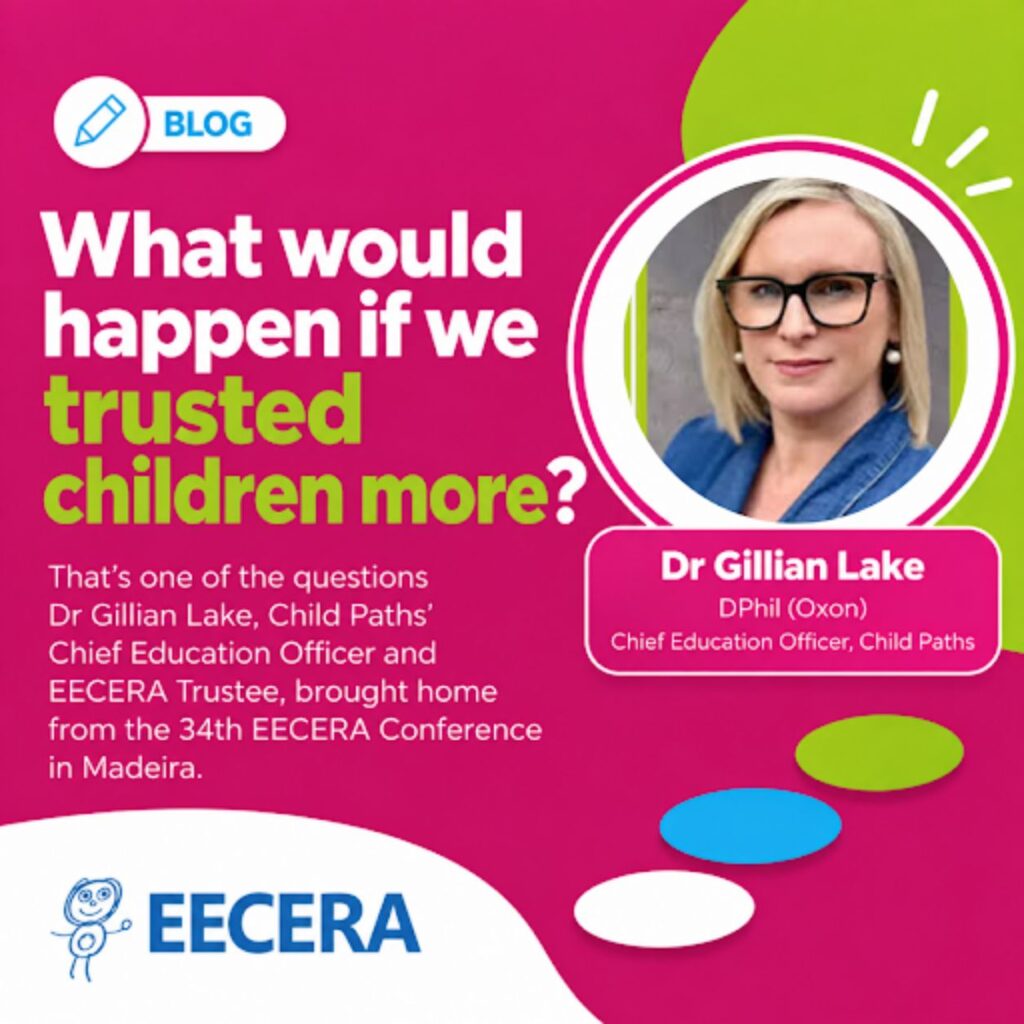
Dr Gillian Lake, Chief Education Officer, Child Paths; EECERA Trustee
I was fortunate enough to attend the 34th European Early Childhood Education Research Association (EECERA) Conference this year on the beautiful and tropical island of Madeira. What an experience that was.
My work as an EECERA Trustee is only getting started, and I feel incredibly fortunate to be able to sit alongside colleagues from across the world and listen to the wonderful stories of research being undertaken in early childhood. Ireland, New Zealand, Hungary, Spain, Australia, Turkey, Portugal and many other countries were represented among the near 800 delegates, creating a rich tapestry of research approaches, perspectives and cultural nuances.
And then there was Madeira.
The warmth of the island, the warmth of its people and the warmth of the conversations made for a very memorable few days.
But it was the conference theme, democracy and participation in early childhood education, that stayed with me most strongly. It could hardly have been more relevant.
In her presidential address, our EECERA President, Professor Chris Pascal, spoke eloquently about the shifting and challenging world of what she described as polycrises. We are living through considerable social, political and technological change, and early childhood does not sit outside of that. Quite the opposite. Our youngest children are growing up in a world where the boundaries between digital and non-digital life are increasingly difficult to distinguish.
So, what does democracy and participation mean for young children in a post-digital world?
That question followed me throughout the conference.
Technology, participation and the child
Professor Suzy Edwards’ keynote gave us much to think about. She challenged us to investigate the philosophy of technology, rather than simply thinking about technology as a collection of tools that we choose to use or not use.One of the most delightful examples she shared came from her research into digital literacy through play using unplugged technology artefacts. Children played with wooden versions of familiar technological objects, including mobile phones. One child carried a wooden phone pressed against their upper chest, while several others repeatedly checked the charging status throughout the day. These beautiful little vignettes showed children drawing on their understandings of technology and incorporating them into their play, relationships and meaning making.
Professor Edwards asked us to consider how we can advance democracy for children in a post-digital world. The idea of critical constructivism particularly resonated with me and with it, the notion that our values need to be considered within the design of technology itself.
This is an important challenge for anyone designing digital tools for educators. Technology is never entirely neutral. What we make visible, what we make easy, what we ask educators to record and what we leave space for all carry values.
The opportunity is to design technology that supports professional agency rather than replacing it. Tools can provide possibilities, connections and prompts, while educators remain the people making the professional decisions.
And that same principle of agency was echoed throughout the conference.
One study exploring children’s participation reminded us that participation does not always look loud. The child running, shouting and actively communicating is participating, but so too is the child watching carefully from the edge, listening, quietly constructing or taking the time to work out what they want to say. If we are to understand children’s participation, we need to stop and really look and listen with our eyes.
That has implications not just for how we observe children, but for how we design environments, curriculum and the systems we use to document learning. If we only capture what is easily visible or measurable, we risk creating a very narrow picture of children’s agency.
Another study explored children’s agency during shared book reading and demonstrated how actively children use illustrations to communicate, interpret and make sense of stories. It was a lovely reminder that the whole book is an opportunity for participation, not simply the words on the page.
I was also struck by research examining the phrase “best interests of the child.” It is a phrase we use constantly and indeed is represented in worldwide documents including the UNCRC. Yet there is no single shared definition of what it means. Often, children’s best interests are defined from an adult or professional perspective.
But what do children themselves believe is in their best interests?
That simple question challenges us to think differently about power. If we genuinely believe in participation, perhaps we need to become more comfortable with making decisions with children rather than simply for them.Reema Patel’s keynote reinforced this beautifully through the idea of “nothing about them without them.” Her work on activating agency with Elgon Social Research made us think about the role adults play in creating the conditions for participation, and whether technology can enhance children’s life chances rather than simply becoming another mechanism for managing risk.
And then came Professor Julia Forminsho, our own EECERA Trustee and a personal hero of mine.
Julia spoke with such care about pedagogy and participation, reminding us that democracy begins with us. Before we can genuinely enable children’s participation, we need to examine our own mindsets.
Her emphasis on “we-ness” and on creating space for voice and time, what she described as ethical suspension, really stayed with me. We need to allow children’s curiosity, questioning and intuition to develop.
The response from the room said everything. A spontaneous standing ovation followed her keynote. It felt like a moment of collective recognition.
What might we take forward?
Across the conference, I kept returning to one central idea: real participation requires a shift in power.
For educators, this means questioning our assumptions about what participation looks like and becoming better at noticing the quieter, less immediately visible ways children communicate.
For researchers, it means continuing to ask whose voices are represented and whose are missing.
For those designing technology for educators, it means thinking carefully about the values embedded within our systems. Digital tools can make things easier, but they can also shape what we notice, what we record and what we consider important.
Perhaps our ambition should be technology that helps educators listen more deeply, respond more flexibly and exercise their professional judgement.
Technology should not close possibilities. It should open them up.
I also attended sessions exploring folk tales and children’s wellbeing, reviews of ECERS, STEAM in early childhood and the challenges of supporting indigenous languages in early literacy. The breadth of the research was extraordinary and once again reminded me that early childhood education cannot be separated from questions of identity, culture, language, wellbeing, relationships and society.
We also heard about the realities facing the early childhood workforce in Ireland, including staff turnover of 22.4%, with pay and conditions continuing to create significant challenges. It was striking to hear similar concerns echoed across many of the countries represented.
And then there was Madeira itself.
The wonderful APEI team who organised the conference on the ground. The taxi drivers greeting us with a smile as they navigated the many hills of Funchal. The sunset boat trip, complete with dolphins and whales frolicking alongside us. The lights of the houses scattered across the hillside as we sailed back into Funchal.
And, thankfully, the little fan in our conference bags, which became one of my most treasured possessions in the Madeira heat!
Leaving Madeira
Perhaps my biggest takeaway was not a particular paper, model or presentation. It was a renewed belief in the importance of real participation.
Laura Lundy’s model continues to provide such a valuable foundation for thinking about children’s participation, and it was wonderful to see it underpinning so much of the research being presented.
The friendships made and maintained over those few days were just as important as the formal programme. Conferences such as EECERA remind me that research is not something that happens in isolation. It is a conversation that crosses countries, cultures, disciplines and perspectives.
I left Madeira feeling energised.
Energised by the research.
Energised by the conversations.
Energised by the friendships.
And energised by the responsibility we have to continue advocating for, researching with and engaging meaningfully with early childhood education.
The question of democracy is not going away. Nor should it.
If anything, as our world becomes more complex and more digital, our commitment to children’s voice, agency and participation needs to become stronger.
We need to keep asking:
Who gets to decide?
Whose voice are we hearing?
What are we overlooking?
And perhaps most importantly:
What would happen if we trusted children a little more?
There is much work to do.
And I am very glad to be part of it.
Bring on Zagreb EECERA 2027!