In Early Childhood Education and Care (ECEC), curriculum planning is increasingly moving away from pre-determined activities towards a deeper understanding of children’s lived experiences, interests, and identities. As the updated Aistear framework continues to emphasise responsive, rights-based and relational practice, educators are being encouraged to recognise that children arrive into settings already rich in knowledge, experiences, and understandings.
The new Curriculum Preparation feature within Child Paths has been designed with this philosophy at its core. Rather than asking educators simply what activities will be planned, the tool encourages reflection on what babies, toddlers, and young children already know about an emergent or planned interest. In doing so, it supports educators to build curriculum from children’s “funds of knowledge” and “funds of identity.”
Seeing Children as Competent and Knowledgeable
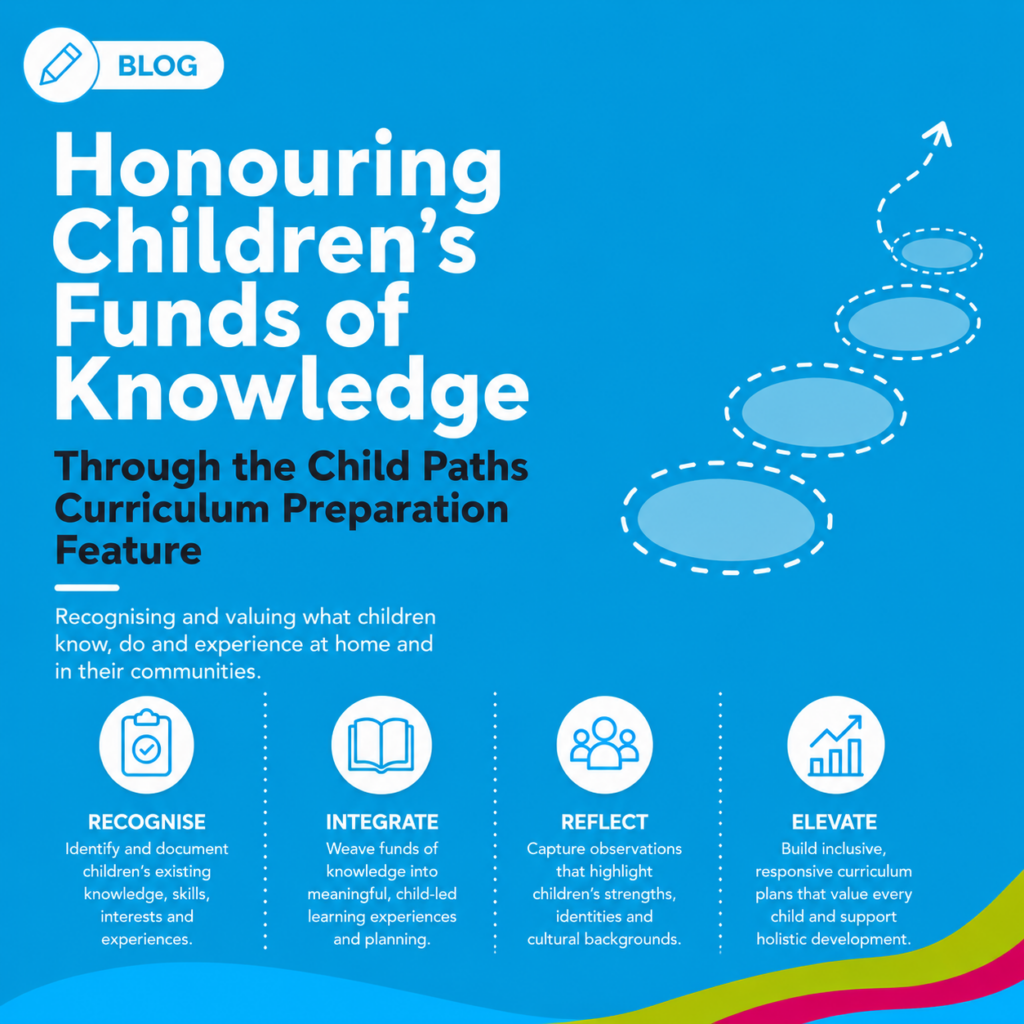
Research consistently highlights that children’s interests emerge from their participation in family and community life. Hedges and colleagues (2011) describe this as a funds of knowledge approach, recognising that all children and families bring valuable experiences, skills, beliefs, and understandings into ECEC settings.
For example, a baby from a passionate GAA family may already have rich experiences connected to sport, attending matches, hearing conversations, wearing jerseys, or playing with hurls and balls at home (French, 2018). These experiences become part of the child’s personalised curriculum long before entering an early years setting.
The Child Paths Curriculum Preparation feature supports educators in identifying and responding to these experiences in meaningful ways. By prompting educators to consider what children already know, the feature encourages curriculum planning that is connected, relevant, and culturally responsive.
This approach shifts curriculum planning from “what will I teach?” to “what matters to this child and how can I build upon it?”
Moving Beyond Activities Towards Meaningful Interests
Too often, children’s interests can be reduced to surface-level topics or activities. However, current research suggests that children’s play choices are deeply connected to their sociocultural experiences and identities.
As Liz Chesworth (2023) explains, children use objects and play experiences to represent the experiences and relationships that matter to them. The interest is not necessarily the toy itself, but the meaning and lived experience behind it.
The Curriculum Preparation feature supports educators in exploring these deeper meanings. Through links to previous curriculum plans and prior learning experiences, educators can trace the continuity of children’s thinking, relationships, fascinations, and inquiries over time.
This creates opportunities for richer, more sustained curriculum journeys rather than isolated activities disconnected from children’s lives.
Supporting Identity, Belonging and Participation
Recent developments in research have expanded the concept of funds of knowledge into funds of identity (Esteban-Guitart & Moll, 2014; Hedges, 2020). This perspective recognises that the experiences children value most strongly contribute to their developing sense of self, belonging, and competence.
The Child Paths feature aligns closely with this thinking by encouraging educators to reflect on children’s emerging identities, relationships, languages, values, and community experiences during curriculum preparation.
Importantly, the feature also supports educators in considering children’s “fundamental inquiries”, i.e. the big questions children explore through play, relationships, and investigation:
- How can I make special connections with people I know?
- How can I understand the world I live in?
- How can I express my creativity?
- What can I do now that I am bigger?
- How can I develop my wellbeing?
These inquiries help educators move beyond narrow themes towards a curriculum that is emotionally meaningful, intellectually engaging, and deeply connected to children’s everyday lives.
Bridging Planned and Lived Curriculum
Curriculum theorist Aoki (1993) described the importance of educators occupying the “middle space” between curriculum as a plan and curriculum as lived experience. This requires educators to genuinely enter into children’s worlds while inviting children into shared processes of meaning-making and reflection.
The Child Paths Curriculum Preparation feature supports this relational process by linking current planning to previous observations, learning records, and experiences. In doing so, educators can see curriculum not as a static document, but as an evolving conversation between children, families, educators, and communities.
Conclusion
The new Child Paths Curriculum Preparation feature offers educators a thoughtful and reflective way to plan curriculum that honours children’s lived experiences, identities, and interests. By foregrounding funds of knowledge and encouraging educators to build from what children already know and care about, the tool supports curriculum that is meaningful, participatory, and deeply connected to children’s worlds.
In this way, curriculum preparation becomes more than planning activities. It becomes a process of listening, noticing, connecting, and co-constructing learning with children at the centre.
References
Aoki, T. (1993) ‘Legitimating lived curriculum: Towards a curricular landscape of multiplicity’, Journal of Curriculum and Supervision, 8(3), pp. 255–268.
Chesworth, L. (2014) ‘A funds of knowledge approach to examining play interests: Listening to children’s and parents’ perspectives’, International Journal of Early Years Education, 22(3), pp. 323–334.
Chesworth, L. (2016) ‘Children’s engagement with popular culture: A funds of knowledge perspective’, Early Years, 36(4), pp. 440–452.
Chesworth, L. (2023) ‘Children’s interests, funds of knowledge and funds of identity in early childhood education’, Early Child Development and Care, 193(5), pp. 721–735.
Chesworth, L. and Hedges, H. (2023) ‘Understanding children’s interests through funds of knowledge, funds of identity and fundamental inquiries’, Contemporary Issues in Early Childhood, 24(2), pp. 145–159.
Dockett, S., Perry, B. and Kearney, E. (2013) Starting School: Perspectives from Australia. Sydney: UNSW Press.
Esteban‐Guitart, M. (2016) Funds of Identity: Connecting Meaningful Learning Experiences in and out of School. Cambridge: Cambridge University Press.
Esteban‐Guitart, M. and Moll, L. (2014) ‘Funds of identity: A new concept based on the funds of knowledge approach’, Culture & Psychology, 20(1), pp. 31–48.
French, G. (2018) Supporting Babies’ and Toddlers’ Learning Through Aistear. Dublin: National Council for Curriculum and Assessment.
Gutiérrez, K. and Rogoff, B. (2003) ‘Cultural ways of learning: Individual traits or repertoires of practice’, Educational Researcher, 32(5), pp. 19–25.
Hedges, H. (2011) ‘Connecting “snამდვილ real life” experiences and interests with learning in early childhood settings’, Australasian Journal of Early Childhood, 36(1), pp. 79–87.
Hedges, H. (2020) Children’s Interests, Inquiries and Identities: Curriculum, Pedagogy, Learning and Outcomes. London: Routledge.
Hedges, H. (2022) ‘Funds of identity in early childhood curriculum and pedagogy’, Curriculum Perspectives, 42(2), pp. 211–220.
Hedges, H., Cullen, J. and Jordan, B. (2011) ‘Early years curriculum: Funds of knowledge as a conceptual framework for children’s interests’, Journal of Curriculum Studies, 43(2), pp. 185–205.
Moll, L., Amanti, C., Neff, D. and Gonzalez, N. (1992) ‘Funds of knowledge for teaching: Using a qualitative approach to connect homes and classrooms’, Theory Into Practice, 31(2), pp. 132–141.
Poole, A. (2017) ‘Young children’s use of digital media and funds of knowledge’, Early Child Development and Care, 187(8), pp. 1213–1225.