The redevelopment of the Curriculum Preparation feature within Child Paths is intentionally aligned with current inspection frameworks and regulatory expectations, while remaining firmly grounded in high-quality early childhood pedagogy. The revised Aistear framework (NCCA, 2024), Síolta Standards, and Tusla Early Years Inspectorate guidance consistently emphasise intentional planning, continuity of learning, reflective practice, inclusion, and meaningful documentation of children’s learning and development. This feature is designed to support educators to evidence these practices in ways that are authentic, manageable, and pedagogically sound.
Inspection guidance requires that services demonstrate how curriculum planning is informed by observation, assessment, and children’s interests, and how it supports progression over time. Educators are expected to show clear links between planning, implementation, and review, including how learning experiences align with Aistear’s themes, learning outcomes, dispositions, and wellbeing. The revised Child Paths planning feature directly supports this requirement by explicitly connecting the curriculum statement and medium-term preparation within a single, coherent framework. This enables services to demonstrate continuity and progression in learning without imposing rigid or linear planning structures that contradict emergent curriculum principles.
Importantly, inspectors increasingly recognise that high-quality curriculum planning in ECEC is flexible, responsive, and context-specific. Educator feedback highlights that much planning occurs through professional dialogue, observation, and in-the-moment decision-making, rather than through extensive written plans. The Child Paths feature responds to this reality by enabling educators to capture spontaneous planning and professional judgement efficiently, providing proportionate evidence of reflective practice without increasing administrative burden. This aligns with inspection expectations that documentation should be purposeful, manageable, and reflective of everyday practice.
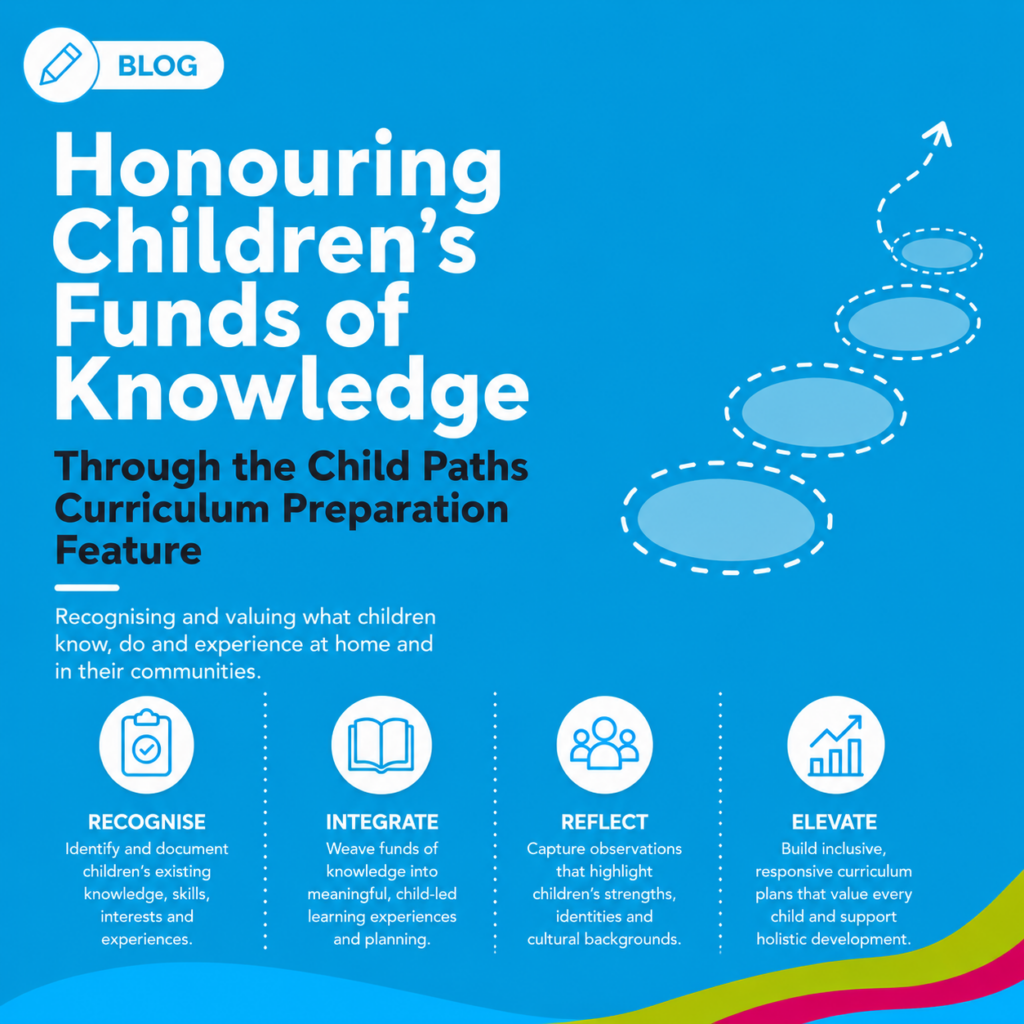
The feature also supports inspection requirements relating to inclusion, equality, and access. By embedding prompts related to children’s individual needs, emergent interests, schemas, dispositions, and funds of knowledge, the planning tool enables services to demonstrate how curriculum provision is differentiated and inclusive, in line with the Access and Inclusion Model (AIM) and anti-bias practice. This supports inspectors’ focus on how settings respond to diversity, promote equity, and ensure that all children can participate meaningfully in the curriculum.
Assessment and documentation elements within the planning feature align with Aistear’s reflective cycle and guidance on observing, recording, and using assessment information to inform next steps. Educators are supported to link planning decisions to observations and learning records, making learning visible while respecting the complexity and non-linear nature of early learning. This provides clear evidence of ongoing assessment, review, and curriculum evaluation, which are key areas of inspection focus.
Family partnership is another central inspection priority. The revised planning feature supports services to demonstrate how parents’ knowledge, perspectives, and contributions inform curriculum decisions, in line with Aistear and Síolta expectations regarding partnership with families. This enables services to evidence communication, collaboration, and shared understanding of children’s learning.
Overall, the Curriculum Preparation feature has been designed to support services to meet inspection and regulatory requirements by strengthening pedagogy rather than diluting it. It enables educators to articulate and evidence high-quality, reflective, child-centred practice in ways that align with inspection language, while remaining faithful to the lived realities of early childhood education and care.